Hungarian planetary scientists · 184–185
Szaniszló Bérczi
Zoom with the mouse wheel inside the image or use the buttons. Drag the enlarged image with the hand cursor; swipe to move on a touchscreen.
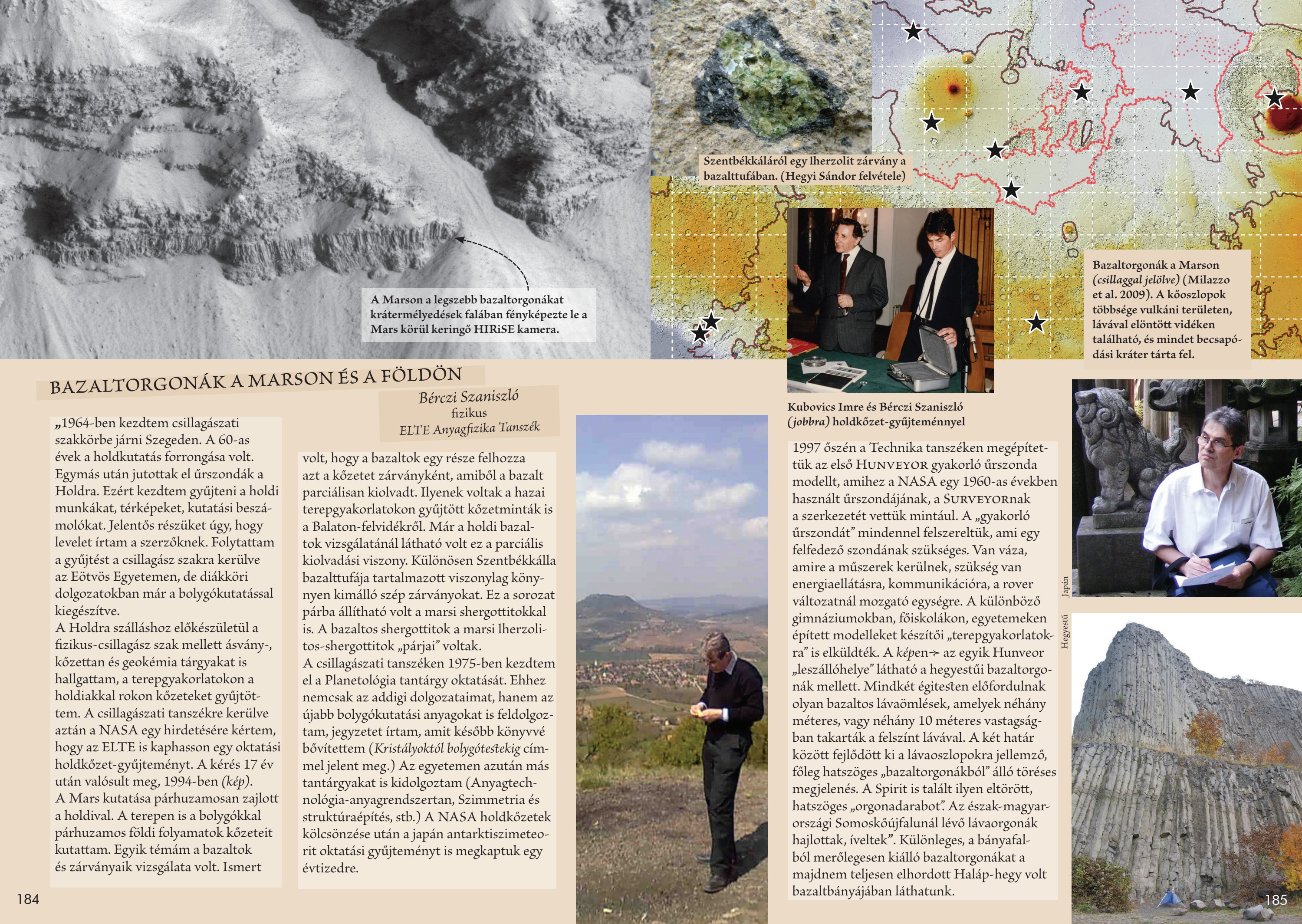
Szaniszló Bérczi: “I began attending an astronomy club in Szeged in 1964. The 1960s were an exciting time for lunar research: one probe after another reached the Moon. I began collecting lunar papers, maps and research reports, often by writing to their authors. I continued while studying astronomy at Eötvös Loránd University, extending my student research to planetary science. To prepare for the Moon landings, alongside physics and astronomy I studied mineralogy, petrology and geochemistry, and collected related rocks during fieldwork. After joining the astronomy department, I responded to a NASA advertisement requesting a lunar rock teaching collection for ELTE. The request was fulfilled seventeen years later, in 1994.”
Szaniszló Bérczi: “I began teaching Planetology in the astronomy department in 1975. I used both my earlier papers and new planetary research to prepare teaching notes, later expanded into the book Kristályoktól bolygótestekig (From Crystals to Planetary Bodies). I subsequently developed other university courses, including material technology and classification, and symmetry and structure building. After borrowing NASA’s lunar rocks, we also received a Japanese Antarctic meteorite teaching collection for a decade.”
Szaniszló Bérczi: “In autumn 1997, our technology department built the first Hunveyor training spacecraft model, using the structure of NASA’s 1960s Surveyor probe as a template. We equipped it with everything an explorer needs: a frame for instruments, power, communication and, for the rover version, a mobility unit. Models built in secondary schools, colleges and universities were also sent on field trips. The picture shows a Hunveyor landing site beside the columnar basalt at Hegyestű.”