Hungarian planetary scientists · 183
István Viczián
Zoom with the mouse wheel inside the image or use the buttons. Drag the enlarged image with the hand cursor; swipe to move on a touchscreen.
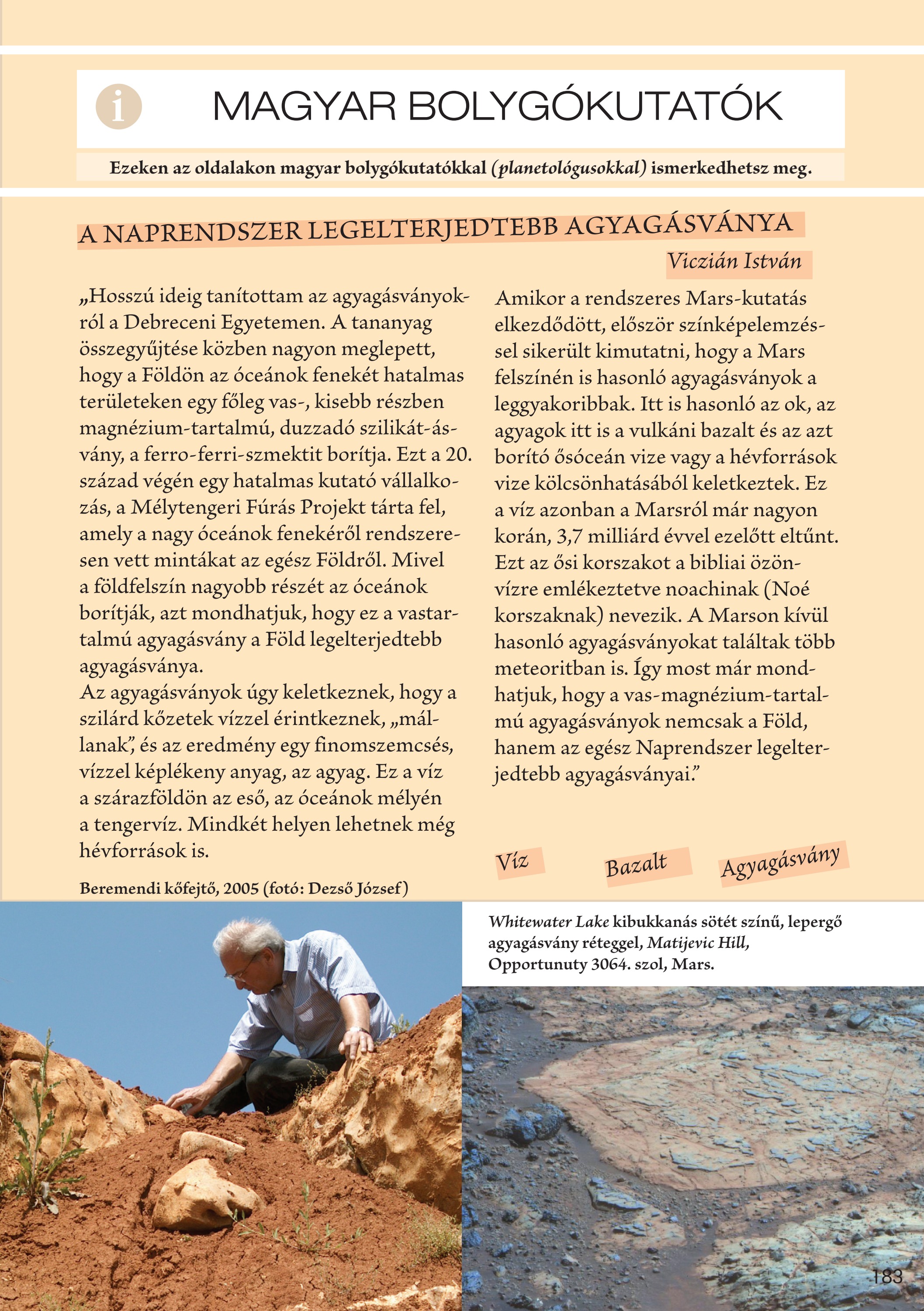
István Viczián: “I taught clay mineralogy at the University of Debrecen for many years. While preparing teaching materials, I was surprised to learn that vast areas of Earth’s ocean floors are covered by ferro-ferric smectite, a swelling silicate containing mainly iron and some magnesium. The Deep Sea Drilling Project revealed this in the late twentieth century by systematically collecting samples from ocean floors worldwide. Because oceans cover most of Earth’s surface, this iron-bearing mineral can be called Earth’s most widespread clay mineral. Clays form when solid rocks contact water and weather, producing fine-grained material that becomes plastic when wet. On land this water is rain; in the deep oceans it is seawater. Hot springs may occur in either setting.”
István Viczián continues: “When systematic Mars research began, spectroscopy first showed that similar clay minerals were also the most common on Mars. Here too, the clays formed through interaction between volcanic basalt and water from an ancient ocean or hot springs. This water disappeared very early, 3.7 billion years ago. The ancient period is called Noachian, recalling Noah and the biblical flood. Similar clays have also been found in several meteorites. We can therefore say that iron-magnesium clay minerals are the most widespread clays not only on Earth but throughout the Solar System.”