Thematic maps and Martian landscapes · 107
Cloud maps and climate diagrams
Zoom with the mouse wheel inside the image or use the buttons. Drag the enlarged image with the hand cursor; swipe to move on a touchscreen.
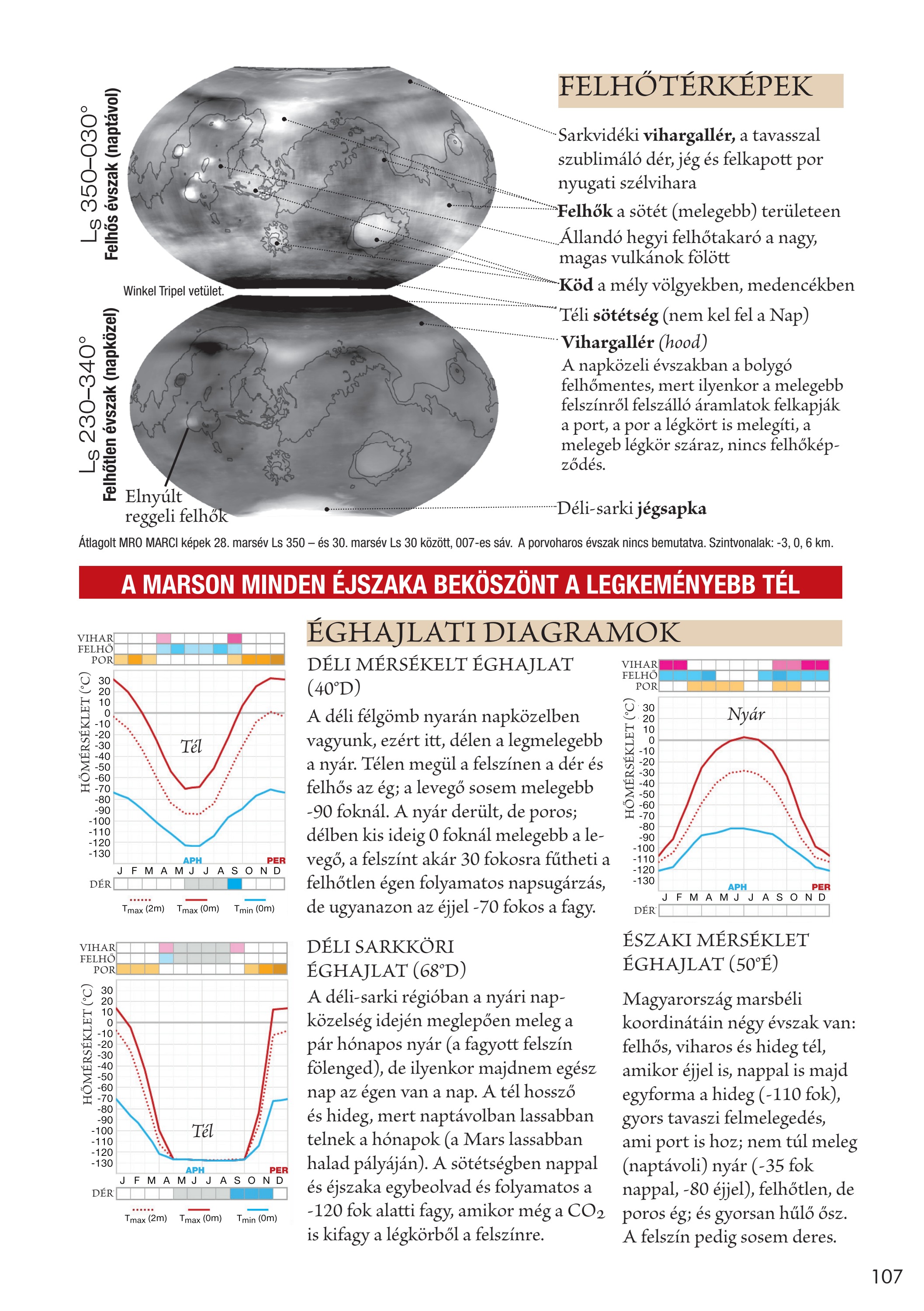
During the season near perihelion, the planet is cloud-free: rising currents above the warmer surface lift dust, which heats the atmosphere. The warmer atmosphere is dry and clouds do not form.
Southern summer occurs near perihelion and is the warmest summer. In winter, frost settles on the surface, skies are cloudy and the air never exceeds −90 °C. Summer is clear but dusty. Around noon the air briefly rises above zero, and continuous sunlight can heat the ground to 30 °C, although the same night falls to −70 °C. In the south polar region, summer near perihelion is surprisingly warm for a few months and frozen ground thaws, while the Sun stays above the horizon almost all day. Winter is long and cold because Mars travels more slowly near aphelion. Day and night merge in darkness, with temperatures continuously below −120 °C, cold enough for carbon dioxide to freeze onto the surface. At the Martian coordinates corresponding to Hungary, there are four seasons: a cloudy, stormy, cold winter with similar temperatures day and night, near −110 °C; rapid spring warming bringing dust; a relatively cool summer near aphelion, about −35 °C by day and −80 °C at night, under clear but dusty skies; and rapid autumn cooling. The ground never becomes frosted.