Volcanism in the Solar System
English
Machine translation from the Hungarian original.
Volcanism in the Solar System
Written by Henrik Hargitai; scientific review by Ákos Kereszturi. Published in: Dávid Karátson: Volcanology II. . ELTE Eötvös Publishing Ltd.
1. Formation and types of celestial bodies in the Solar System
About 4.6 billion years ago, silicates and metallic grains condensed from the protoplanetary disk around the Sun in the higher-temperature zone closer to the Sun. These grains stuck to each other, collided and formed bigger bodies - by accretion - to create the Earth-type planetary bodies (this includes the Moon and Jupiter's moon Io with a silicate crust). Farther from the Sun, approx. beyond the "frost line" (frost line) at the distance from the Sun between the current orbits of Mars and Jupiter, H2O has also precipitated, thus water has also been incorporated into the material of celestial bodies formed in the Outer Solar System; moving away from the Sun, it became dominant. The celestial bodies with a solid surface in this region are called icy celestial bodies. In both zones (dominated by rock and ice), celestial bodies of irregular shape, typically less than 300 km in diameter, were created, e.g. asteroids, irregular moons, comet nuclei. These have an irregular shape because they did not melt, so they did not take on the shape of a drop, i.e. a sphere; they did not get past the accretion phase, magmatic processes did not take place on them.
2. Thermal evolution of planetary bodies
By the end of the accretion phase, all planetary bodies have accumulated a significant amount of heat inside from the energy of the impacts (accretion heat). The internal heat is also contributed by the heat released during the arrangement according to density in the melt, i.e. the gravitational separation of the metallic core and silicate mantle (metals sink into the core, silicates rise to the surface) (differentiation heat) (Breuer and Moore, 2007). Especially at the beginning of the planet's evolution, there was a significant amount of heat from radioactive decay, primarily in the approx. 26Al isotope with a half-life of 700,000 years, the decay of which could have been a strong impulse in melting the surface of planetary bodies.
According to some planetary development models, at the end of the accretion phase of planetary development, the large celestial bodies did not have a solid crust, but their surfaces were covered by a "magma ocean" (Elkis-Tanton, 2012). After the frequency of collisions decreased significantly, i.e. they "ran out", larger planetesimals also collided, and the first solid crust could form on the surface of the planetary bodies. Simultaneously with the cooling of the surface, the water content of the primordial atmosphere could have precipitated, so oceans of water could have accumulated in the primary crust on Earth, and probably on Venus as well. However, this crust could be melted again and again by the last giant impacts. Traces of these – impact basins – are still preserved on the Moon, Mars and Mercury. On Earth and Venus, it is likely that they were formed, but they were not preserved. As a result of the large impacts, the material of the existing bodies of water could have evaporated again into the atmosphere. If life had developed during more peaceful periods, these impacts could have sterilized the planet several times over.
The material of the primary crust could have already differentiated, i.e. it could have a different composition on the surface than in the mantle. This is clearly visible in the duality of the Moon's anorthosite crust (highlands) and its basaltic volcanism fed from a deeper source (mare areas) – however, it is not certain that the process took place in this way on other celestial bodies. The material of the primary crust on Venus and Earth is not preserved on the surface.
After the depletion of short-lived radioactive isotopes, the decay of isotopes (235U, 238U, 232Th, 40K) with a longer half-life of the order of billions of years, enriched in the crust and depleted from the mantle, still provides the main source of heat for volcanism on the larger Earth-type planets. Another source of heat is tidal friction heat production, the effect of which is the Earth-Moon resp. It also occurs in the slowing down of the Earth's rotation in the Earth-Sun relationship. The heat production caused by tidal friction lasts until the planetary body becomes in closed orbit, i.e. when it always turns the same side towards the other celestial body. There are no planets in our solar system with a fixed orbit, because even the closest one is too far from the Sun.
Accretion and differentiation heat was generated only at the beginning of planetary body development, radioactive heat is continuously produced, but at an exponentially decreasing rate, and tidal heat can also be continuously produced, but depending on the current circulation and orbital elements, it can even be episodic (Illés, 2001, Bérczi et al. 2010). The majority of the Earth's heat production is heat of radioactive origin. Heat can be released by convection (through mantle currents, below the surface, earlier in the magma ocean phase, possibly also on the surface), conduction (surface heat flow through the oceanic and continental crust, approx. 20-300 mW/m2), volcanism, and the release of heat from mid-ocean ridges and subduction zones, primarily related to plate tectonics on Earth.
Signs of plate tectonics are found on both Venus and ancient Mars, but these are of local importance; according to assumptions, the lack of water can explain why global plate tectonics did not develop outside the Earth.
Mercury and the Moon currently emit little heat through heat flow through their surface, internal heat can also escape through hot spots on Venus (Kereszturi 1995) and to a lesser extent - in the past with a more significant proportion - on Mars as well (Kereszturi 2006). In the case of Venus, whose crust is not divided into crustal plates similar to Earth's, the researchers developed two types of thermal development models. In the catastrophic (episodic) surface regeneration model, this heat is not released gradually, but accumulates under the crust until it melts it and is released in a global volcanic event, during which a large part of the planet is covered by lava in a geologically short time, and then the process starts again. According to the episodic model, on Venus approx. 500 million years ago, lava several kilometers thick came to the surface in 10-100 million years, during which the lava surfaces associated with different periods suffered different types of deformation, so the different types of surfaces form stratigraphic floors that can be correlated with each other. In this way, a sequence can be defined in which the lobed and smooth plains, fold-ridge plains, shield plains, plains divided by ridges, and lava plains densely divided by fractures follow one another in time (increasingly older) (Ivanov and Head 2011). In the alternative, equilibrium model, continuous hot spot volcanism occurring globally in random locations helps release the heat accumulated under the well-insulating crust. In this model, the surfaces with various deformations do not indicate that they were created at the same time, globally, but were created locally in all periods of the planet's development (Guest and Stofan 1999).
We know nothing about the past volcanism of Io: it is not known, for example, whether the strong volcanism currently experienced is episodic, long-lasting or a unique phenomenon in Io's history. Europe's past is similarly unknown. The current two types of surface, the light ice plains (ridged plains) interwoven with prominent cracks and the darker areas (mottled terrain) with a chaotic surface, which degrades the previous one and is fragmented into ice sheets, probably formed as a result of heat from the depths (mottled terrain), may arise in two alternating phases of surface development, but it is also possible that their formation can take place simultaneously in different parts of the moon (Pappalardo et al. 1999).
The heating is volumetric, while the heat release is superficial. Smaller celestial bodies lose their initially smaller internal heat reserves faster than larger ones, because a smaller celestial body has a larger surface per unit volume, i.e. faster surface heat release. That is why recent volcanism, which is an intense form of internal heat release, can only be found in the Solar System on rocky planets that have preserved their internal heat reserves. Among the planets, active volcanism at the observation level is known only on Earth. However, 80% of the surface of Venus, which is similar in size to Earth, is max. They are covered by 500-1000 million year old lava plains and new research has found hot spots and nearby lava flows interpreted to be at most a few million years old. So far, no signs of active volcanism have been found on the smaller Mars, but based on crater counts, we have found lava flows that are a few million years old (Kereszturi 2000).
How is it possible that the most geologically active celestial body in the Solar System is not a large rocky planet, but a relatively small moon, Io, which should have cooled by now?
The moons in the Solar System (with the exception of the so-called captured moons orbiting far from the given planet) orbit between them all. Since these had few radioactive isotopes in the first place due to their smaller volume, and celestial bodies with material mixed with ice even less, and their surface heat release is also fast, it is not expected that we will encounter volcanic or magmatic activity on a moon today. However, the bound orbit is not necessarily perfect: if the moon's orbit is not a perfect circular orbit, but elongated (eccentric), then within one orbital period there is a smaller fluctuation in the orbital speed and the distance from the planet. In this case, the tidal bulge moves slightly on the surface during circulation. This creates stresses in the solid crust, which can cause cracks (e.g. on the surface of Europa), and in the ductile mantle it generates heat by causing friction (e.g. currently on Ion) (Illés, 2005). The eccentricity of the orbit may be caused by moons orbiting in an orbit resonant with Io.
Planetary concept of volcano
Considering any celestial body in the Solar System, the concept of magma must be defined in relation to the conditions of the given celestial body (Lopes et al. 2010). Thus, magma on Earth-type planetary bodies (Mercury, Venus, Earth, Moon, Mars, Io) usually consists of silicate melt. On icy celestial bodies (e.g. Europa, Ganymede, Enceladus, Triton) the same role is played by H2O melt. Based on theoretical considerations, the crust of icy bodies (cryosphere) consists of an upper, solid ice-lithosphere and a lower, plastic ice-asthenosphere, under which a liquid water ocean (hydrosphere) is assumed. Beneath this is a (silicate) mantle with a chemical composition different from the crust (Pappalardo and Head 1999). Ice volcanism or cryovolcanism is the process of eruption of H2O in liquid or gaseous state (with or without solid components) or other substances considered volatile on Earth that are solid at the temperature of the surface of the given planetary body (Geissler 2000). An important difference between ice magmatism and magmatism is that the H2O melt can be single-component; and solid ice floats on the surface of liquid water; the silicate lava crust, on the other hand, is denser than liquid lava, so it sinks. Conversely: the melting lava rises because it becomes less dense than its cooler environment, while the melting, warming water sinks (up to 8°C) in an icy environment because it is more dense than its 0°C environment. For cryolava to rise, a mechanism is therefore required that can lift it in a watery medium, i.e. reduce its density, e.g. with bubbles, by changing its composition or by overpressurization (Hand et al. 2009).
If the material emerging from below the surface is classified as volatile on the given celestial body and is not of magmatic origin, i.e. it does not come from the depths, then the resulting structure is not considered a volcano. These are e.g. geysers on Earth. However, the places of Enceladus' H2O gas eruptions - which are also called geysers - can be considered ice volcanoes, because ice is the rock-forming material there.
Since they are not related to magmatic activity, the rock melts created by the surface impact are not considered to be of volcanic origin. Such are the impact melts created in the central zone of the craters created by the meteorite impact or ejected from there. These can also be produced in significant quantities in the event of a giant impact (impact melt sea). A new, theoretical problem for the time being is the melts that can form on the surface of exoplanets with fixed orbits (e.g. Corot-7b) that are so close to their sun that it melts the surface rocks at the subsolar (under the Sun) point, while rocks of the same composition do not melt elsewhere.
The identification of forms found on other celestial bodies (flows, cones, channels, depressions, etc.) as volcanic requires extreme caution. Since we can primarily rely on photogeological methods, the geological interpretation of a given landform requires a joint explanation of the interconnected formations of the entire area. This is not always clear. Based on morphology and geological context, it can be difficult to distinguish whether a meandering valley is of fluvial or volcanic origin (Thomas 2013); whether a cone with a depression at the top is a pingo, pyroclast cone or mud volcano (Bradak and Kereszturi 2002, 2003), whether the material filling a depression from the outside is lava or fluidized rock debris, whether a surface area torn into slabs was formed by water ice, mud or lava. In the case of Venus or the Moon, the influence of liquid surface water can be ruled out with great certainty, but on Mars, not only volcanic, fluvial or glacial processes could have played a role in the formation of the surface of an area, but also all three simultaneously (e.g. in the form of hierdovolcanic activity) or one after the other, where the results of all three processes can be found in the given area.
Regional overview
Volcanic lava plains and lava flows are known on Mercury; however, volcanic structures are not.
Most of Venus is covered by lava plains. According to estimates, there are millions of volcanic cones or shields smaller than 20 km, which are comparable in size and number to the bottom mountains found on the Earth's ocean floor. These small volcanic structures are approx. In 550 places, they are arranged in groups ("shield fields"). From a volcanic structure between 20-100 km in diameter, approx. There are 280 of them, among them steep sided domes ("pancake volcanoes"), variously destroyed fluted domes, mainly eroded by landslides, as well as radially patterned volcanoes ("anemones") characterized by radial lava flows.
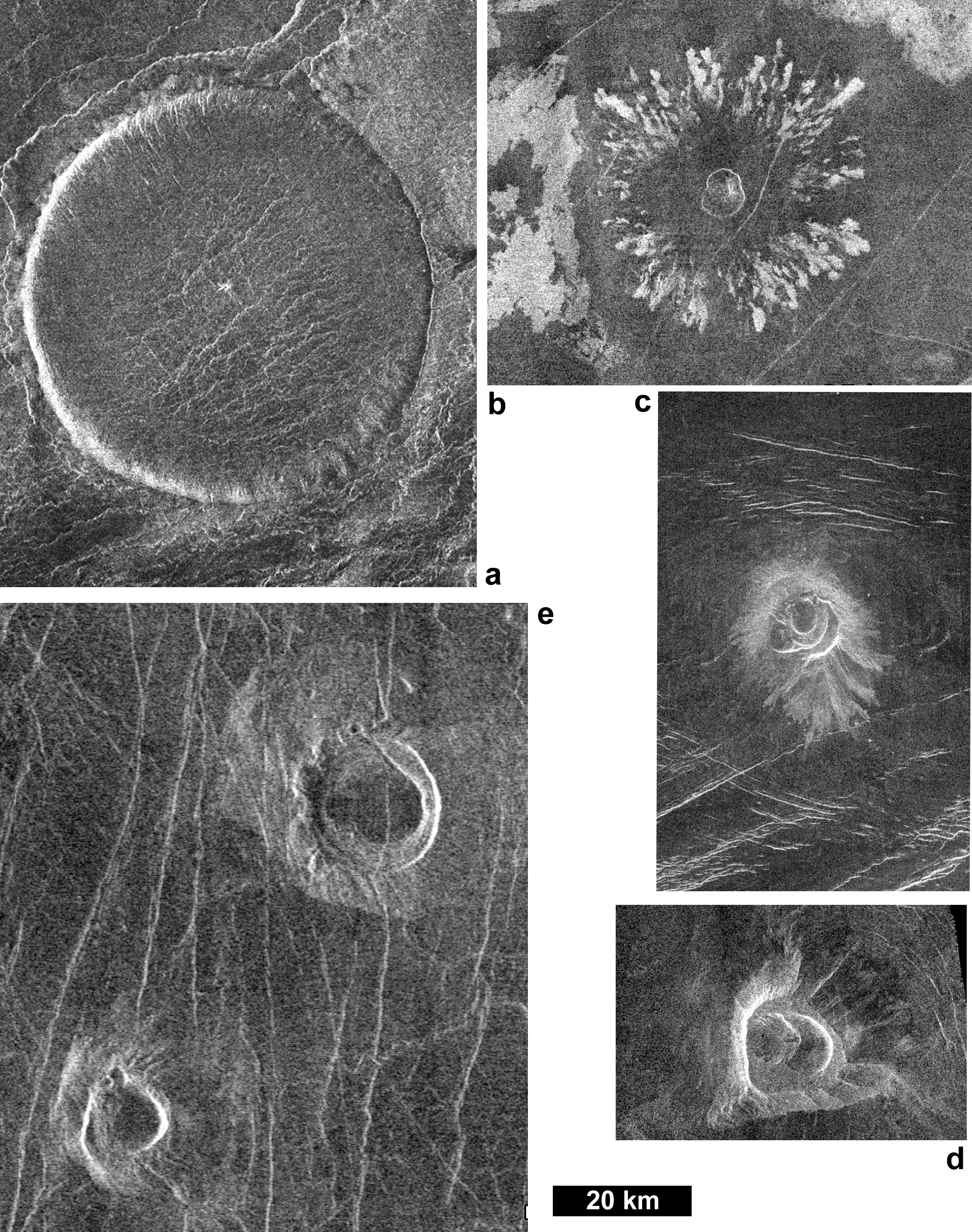
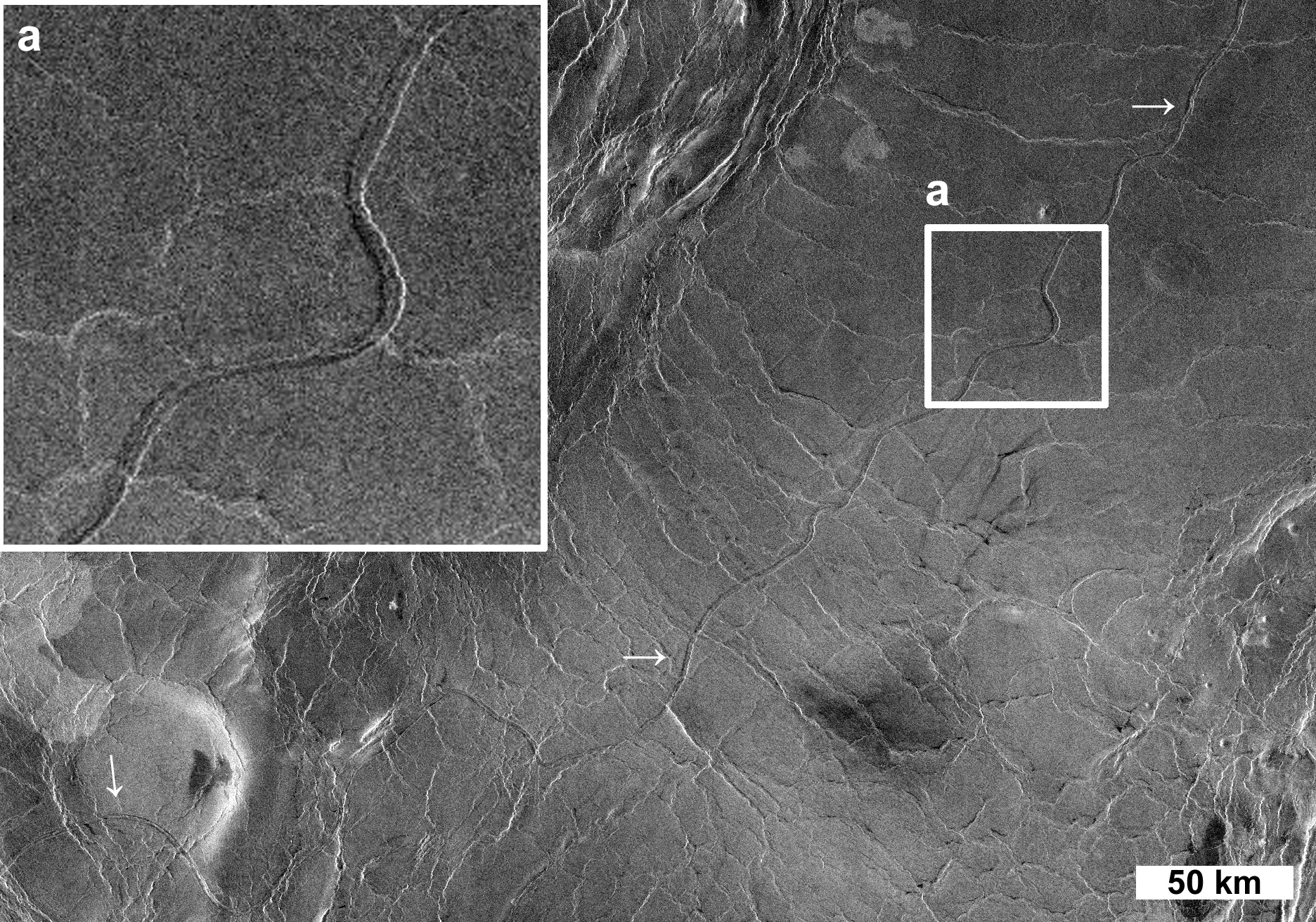
In addition to the above. approx. 150 shield volcanoes larger than 100 km, usually low, which are often closely connected to wide tectonic trenches; approx. There are 90 calderas and hundreds of volcano-tectonic or tectonomagmatic forms (concentric and radial trenches, lava flows and groups of smaller cones with various arrangements: coronas, corona-novae, novae and arachnoids) on Venus. On the volcanic plains approx. 50 lava channels (“canali”) snake through it, the longest of which is more than 6,000 km long. No changes were observed in any of the described shapes during the period of space probe observations. Most of the volcanic formations on Venus are found within the Atla-Beta-Themis triangle. The related landforms of Venus are crater outflows, which are mantle-like, lobular deposits originating from impact craters, similar to lava flows, and presumably formed during the impact. Many ideas were created for their development, such as e.g. that they were formed by the precipitation of debris vaporized by the heat of the impact, or that they are formed by debris fluidized by the dense and hot atmosphere, or that they consist of impact melt, or that the subsurface material with a temperature close to melting was melted by the heat of the impact.
The most well-known formations on the Moon are the dark seas (mare areas) of the Moon, which are ancient impact basins that were later (but still mainly 3.2–3.8 billion years ago) filled by lava flows in several phases. Smaller volcanic domes can also be found in some groups, both in the mare and in the upland (terra) areas. There are many winding valleys, presumably lava channels or collapsed lava tunnels, which originate from pit craters. Based on topographical data, it is assumed that there are huge, very flat shield volcano-like formations under some of the dome groups. Some of the rock samples brought to Earth from the Moon contain volcanic glass droplets of various colors (green, orange, black), which are assumed to have been formed during lava fountain activity. It is now just a historical fact that until the 1960s most of the lunar craters were considered to be of volcanic origin; and the dark plains were believed to be seabed sediments in the 19th century.
The volcanoes of Mars are grouped in three main places: giant and smaller shield volcanoes on the Tharsis and Elysium ridges and ancient, "highland pateras" in the southern highlands (Werner 2009).
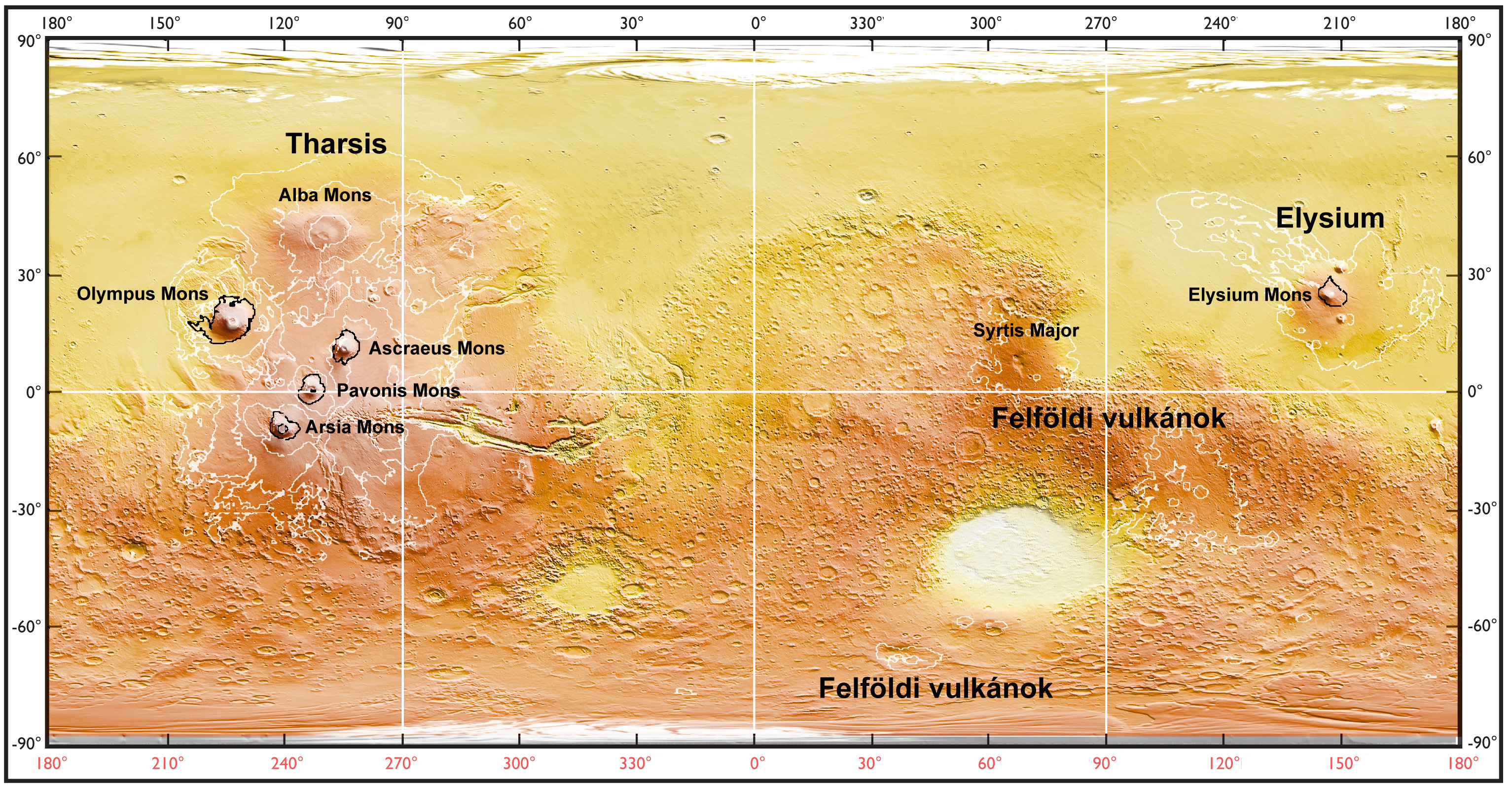
The highest is 600 km in diameter, approx. The 23 km high Olympus Mons shield volcano, which was built in the period 3.6–2.5 billion years ago, but lava flows may have formed on it a few tens of millions of years ago. Several plains on Mars further away from these areas are also assumed to be composed of lava, but this is disputed in many cases. Some of the winding valleys on Mars, e.g. the winding channels on the side of the volcanoes are almost certain to be of volcanic origin, others were probably created by river erosion, however, the origin of some channels cannot be determined with complete certainty based on the available, especially morphological, data. Among the youngest areas of Mars are the lava flows flooding the ancient valleys, on which there are hardly any impact craters. Volcanic activity has so far not been observed on Mars.
Volcanism on Jupiter's innermost moon Io is driven by tidal heat. Practically the entire surface of Io is young, max. It is covered by 10 million year old lava flows. In some places, blocks were pushed out of this surface along fault lines, so it was possible to form approx. 100 tectonic mountains. Among the volcanic formations, only five were found, which have a shape reminiscent of Earth's shield volcanoes. Most volcanic centers can be identified not by a projection (cone, shield), but by a deepening caldera and the visible lava flows around it. The accumulated material of the lava flows surrounding these pateras can form very flat (<1% slope) shield-like protrusions, but a relief model with sufficient accuracy is not yet available to clearly identify them. From the pateras, with the help of space probe observations and ground monitoring of the past decades, approx. At 200, a trace of activity was identified: either a thermal anomaly indicating freshly surfaced lava, or the eruption cloud itself. In more than 30 years of observations, the Prometheus volcano and hot spot have always been found to be active.
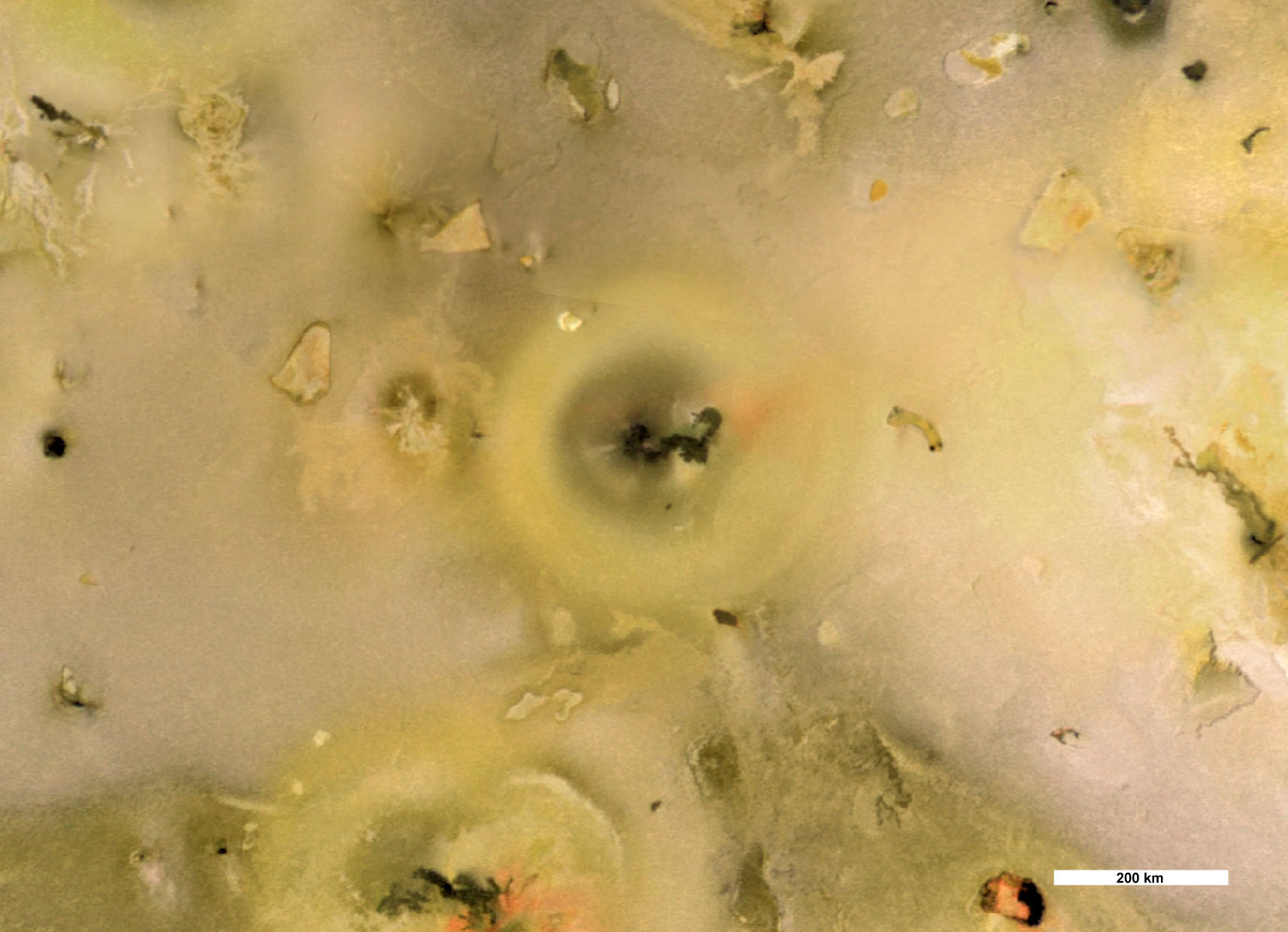
We also know of several lava flows that were created in the meantime. The rings surrounding quite a few of the volcanic centers are mostly yellowish-red in color, which is attributed to the effect of sulfur as a coloring element. It is possible that sulfur is also a material of some lava flows, but it is also conceivable that it is only a surface covering; the substance of the lavas is provided by the silicate magma from the depths, which in places may have been melted by the sulfur that precipitated to the surface.
The only celestial body where active volcanic activity can be directly observed is Io (e.g. Bérczi et al. 2001). Here the observations are approx. Over the course of 30 years, three types of volcanic activity have been distinguished (Davies 2007):
(a) Lava-pouring eruptions: eruptions producing lava flow fields of the order of 100-1000 km2, which are associated with long-term active Prometheus-type eruption clouds, where the interaction of hot lava and the underlying SO2 snow plays a role in the eruption. The typical effusion rate is 10-100 m3/s. Its terrestrial counterpart is the Hawaii-type eruption that produces pahoehoe lava flows.
(b) Explosive eruptions: short-lived, very violent eruptions that are associated with high-temperature (>1200 K) lavas and Pele-type (>500 km high) eruption clouds and originate from fissures. Their counterparts on Earth are fissure volcanoes that produce lava fountains. Also called Pillani volcanism from Pillan Patera.
(c) Intrapatera eruptions: eruptions confined within calderas, such as e.g. the Loki Patera caldera and lava lake. There are lava flows or lava flows inside the calderas. Some paterae are surrounded by scattered pyroclast sediments, suggesting an explosive eruption.
Signs of ice volcanism have been searched for on several moons of the outer solar system, but clear signs can only be found on Enceladus, where eruption columns emerging from a surface fissure were photographed, and a thermal anomaly was also shown in their source area (Kereszturi 2011). Some dark bands on Triton are explained as material falling back from geyser-like eruption clouds; according to some researchers, the smooth area filling some depressions in Europe could also be water (H2O-magma) that flows from the depths to the surface and then freezes. The surface of H2O ice on Titan, Saturn's moon, based on the relatively noisy and low-resolution radar images of the Cassini spacecraft, it is difficult to draw conclusions about the nature of the surface formations. In one place (Sotra Patera) next to a higher mountain, you can see a depression and flow-like formations that have been identified as a volcanic cone, caldera and lava flow.
Types of Volcanoes in the Solar System
Shield volcanoes
Shield volcanoes can be found in a wide range of sizes in the Solar System.
(a) Low and flat shield volcanoes: On Venus, these are volcanic cones with a diameter of less than 20 km and a height of a few hundred meters, which can be found on all kinds of lava plains throughout the planet, in greater numbers on the shield plains and shield fields named after them. Their total number is estimated at 1-4 million. Shield volcanoes with an effusive function, which were formed from a small amount of magma from a shallow source. On Mars, there are very flat (0.5-2°) volcanic structures less than 50 km, lower than 400 m, typically with a central crater, lava channels and extensive lava flows (Kereszturi 2012).
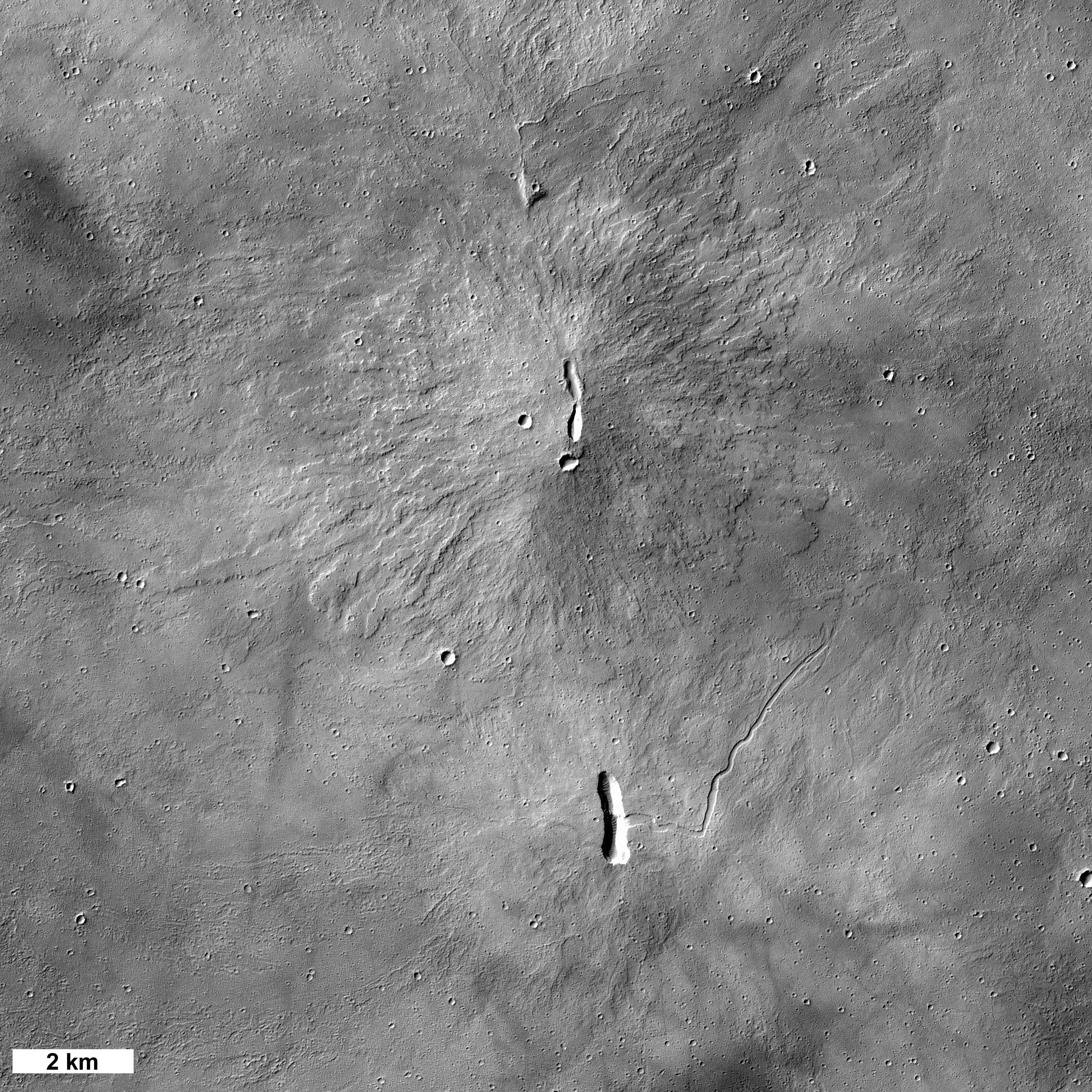
Most of them are 1 km or less in diameter on Mars. They were probably formed as a result of monogenetic fissure volcanism. Like their Venusian counterparts, they occur in groups in some places, but their total number is only in the hundreds. On the Moon, mare domes are domes with a diameter of less than 20 km, a height of less than 500 m, and a slope angle of less than 5°, which is steeper than their counterparts on Mars.
(b) Medium-sized shield volcanoes: On Venus, 20-100 km in diameter, with a caldera or pit crater at their summit; some are visible remnants of volcanic cones (kipukas) that were originally larger, but were half-buried with lava and flowed around. On Mars, tholus (cones) are cones with a diameter of 50-200 km and a height of 4-10 km, with a central caldera. It is possible that they also had explosive phases during their operation. Upland pateras are flatter than cones, 1-2 km high, 200-300 km in diameter structures with a central caldera and radial shapes. They are shield-shaped, but according to assumptions, they are partly of explosive origin and consist of some very easily eroded, presumably tuff-like material. They were created by straight and winding channels or valleys or lava channels or fluvial erosion running down from the caldera.
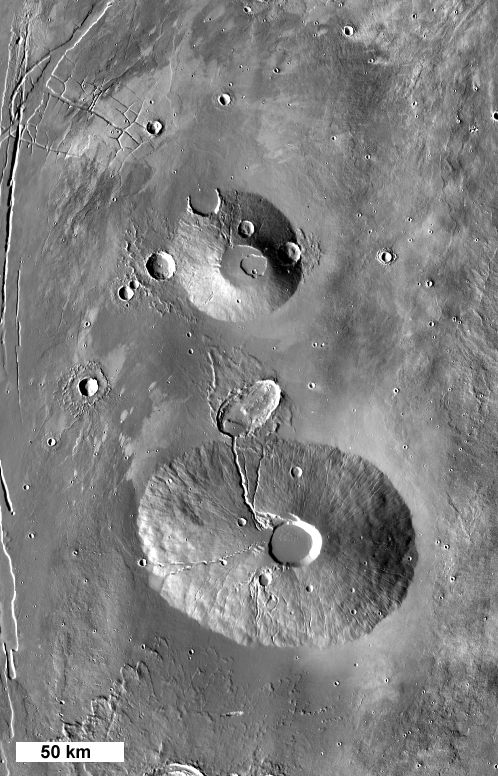
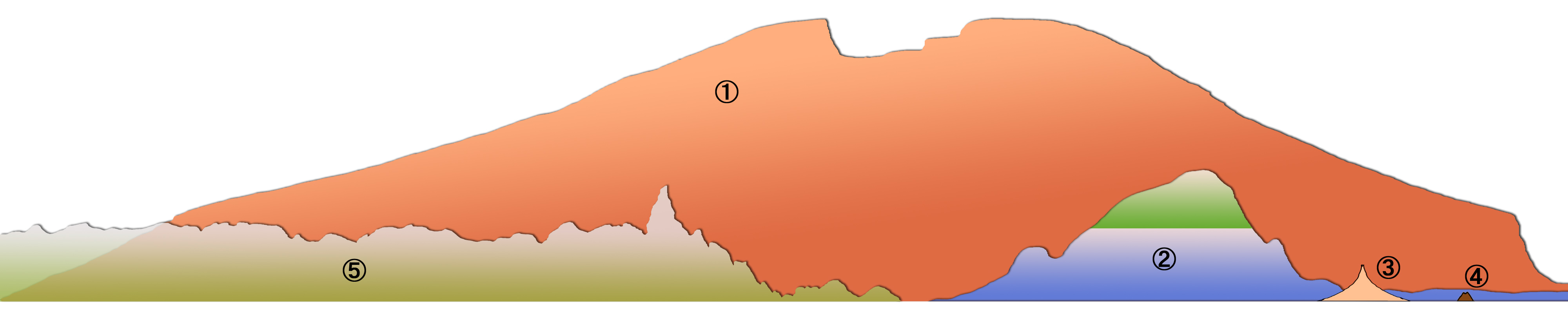
(c) Large shield volcanoes: All the large shield volcanoes on Venus, Mars and the supposed Moon are extremely flat: standing on the surface they would look like plains. The highest ones are 5 km high on Venus, 23 km on Mars, and 2 km on the Moon and hundreds of km in diameter. Typically, there are multiple calderas at their summit. The large shield volcanoes on Venus and Mars are also connected to volcanic rises, dome-like protrusions with a diameter of several thousand km. Lava flows are responsible for a part of the topography, but basically they were created by the dynamic lifting effect of mantle-derived upwelling. They are characterized not only by volcanic cones, but also by groups of radial fault lines, presumably extension trenches.
The large dimensions of shield volcanoes were presumably caused by the fact that, in the absence of plate tectonics, the lava flow over a stable mantle plume took place over the same surface area for a very long time and/or the rate of lava flow was high. At the same time, the "large" Ioan shield volcanoes, meaning large-diameter but flat, consisting of caldera and lava flows, on the contrary, were probably formed in one place with only short activity, a low lava flow rate or very long pauses between individual activities (Schenk et al. 2004).
Pyroclastic cones
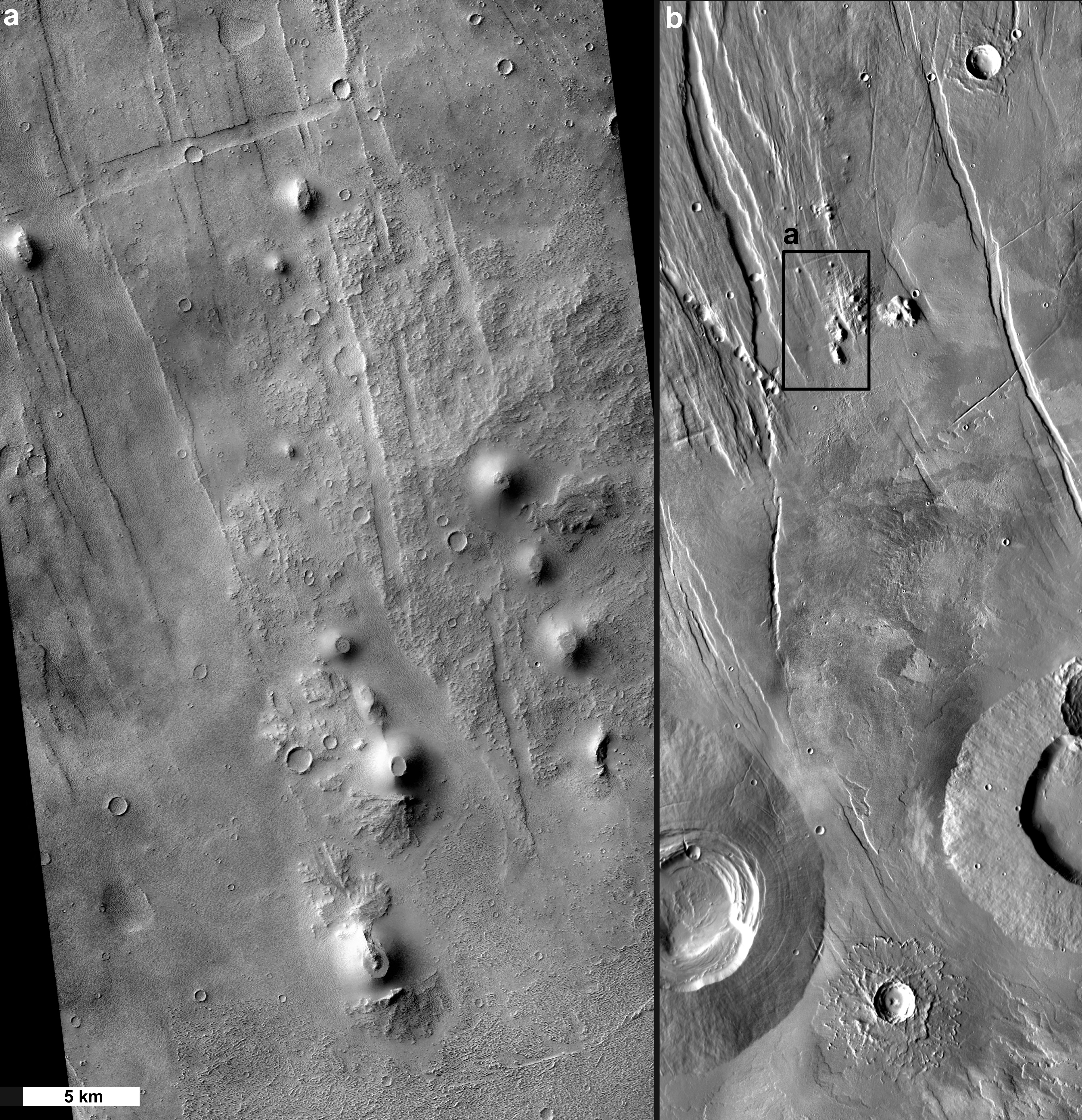
Smaller cones with a diameter of a few km and a height of a few hundred meters, which are built by pyroclastite from a central crater of explosive origin. It is possible that some of the small volcanoes on Venus are pyroclastic cones - the size of the cones is at the resolution limit of the available radar images, and the relief models are of even lower resolution. There are many crater-shaped cones on Mars, the formation of which is disputed, and interpretations range from collapsed pingos to mud volcanoes in some locations. Some are assumed to be cinder cones, and those with wider craters are assumed to be tuff rings. Their identification is important, as it indicates the presence of surface or subsurface water or ice at the time of the formation of the cones, which is an important factor in understanding the surface evolution of Mars.
Stratovolcanoes (composite volcanoes)
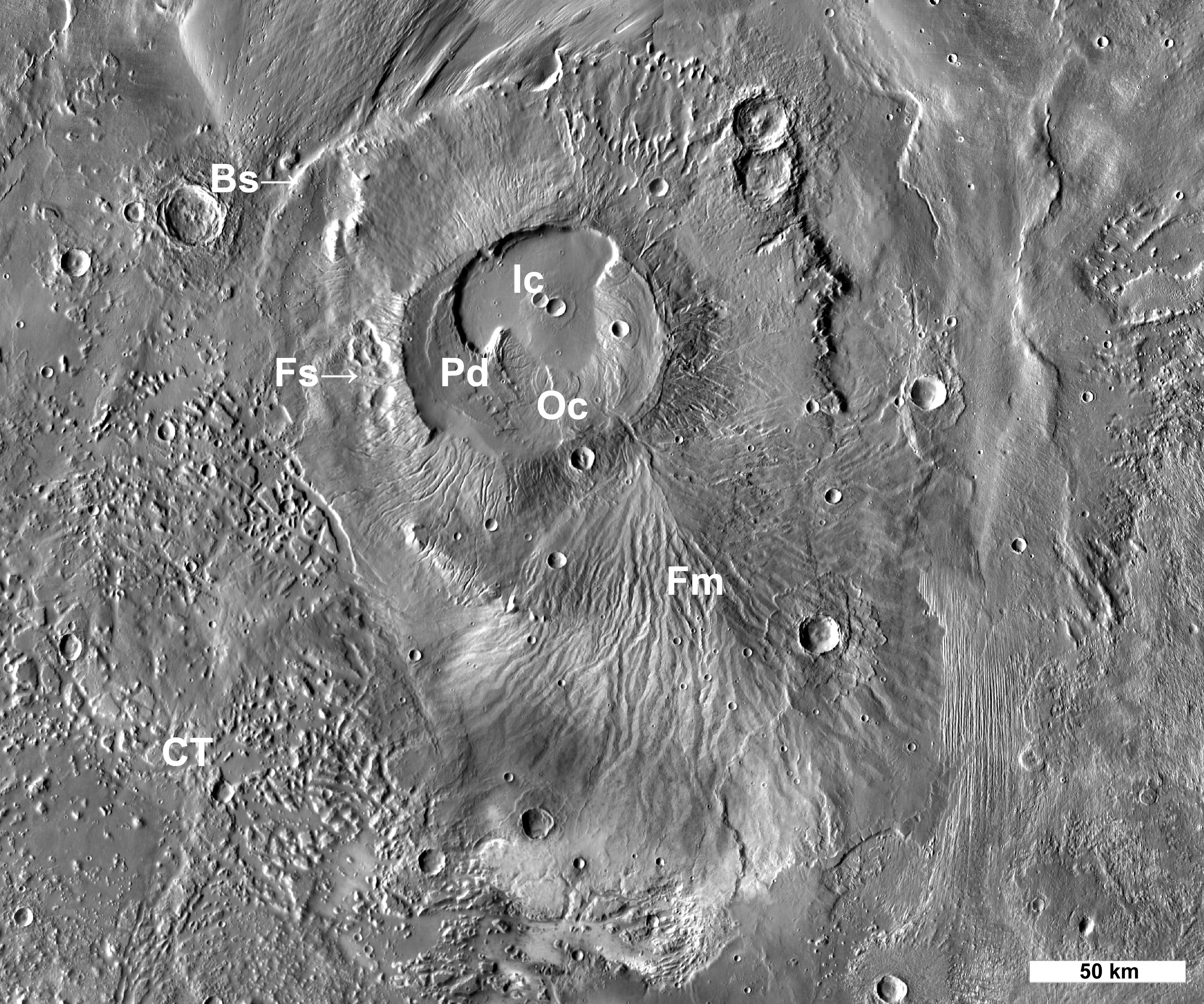
The classic volcanic cones that are common on Earth are not known on other planets. The closest corresponding shapes are the cones, which, on the basis of theoretical considerations, are assumed to have undergone spillover and explosive periods when they were created. Such is Apollinaris Mons on Mars.
Another example could be Io, where volcanic centers connected to pateras (calderas) purely by their operation are characterized by strong eruption cloud activity and lava pouring. The pyroclastite that has fallen back like a ring settles on the widely spreading lavas, i.e. in a certain sense these are also complex volcanoes.
Calderas
Calderas (in the geographical name: patera) on other celestial bodies are usually depressions larger than 10 km in diameter (Mouginis-Mark and Rowland 2001). Most large shield volcanoes on Mars and Venus are characterized by multiple, overlapping calderas formed at different times. On Venus approx. There are 100 calderas, typically with diameters of 60-80 km, connected to numerous radial fracture systems, which are explained as the surface appearance of telomeres. A series of pit craters also developed in some of the trenches, both on Mars and Venus. The appearance of the surface of Io is approx. It is dominated by 425 calderas with an average diameter of 40 km, most of which are also hot spots, and active lava lakes have also been observed in them.
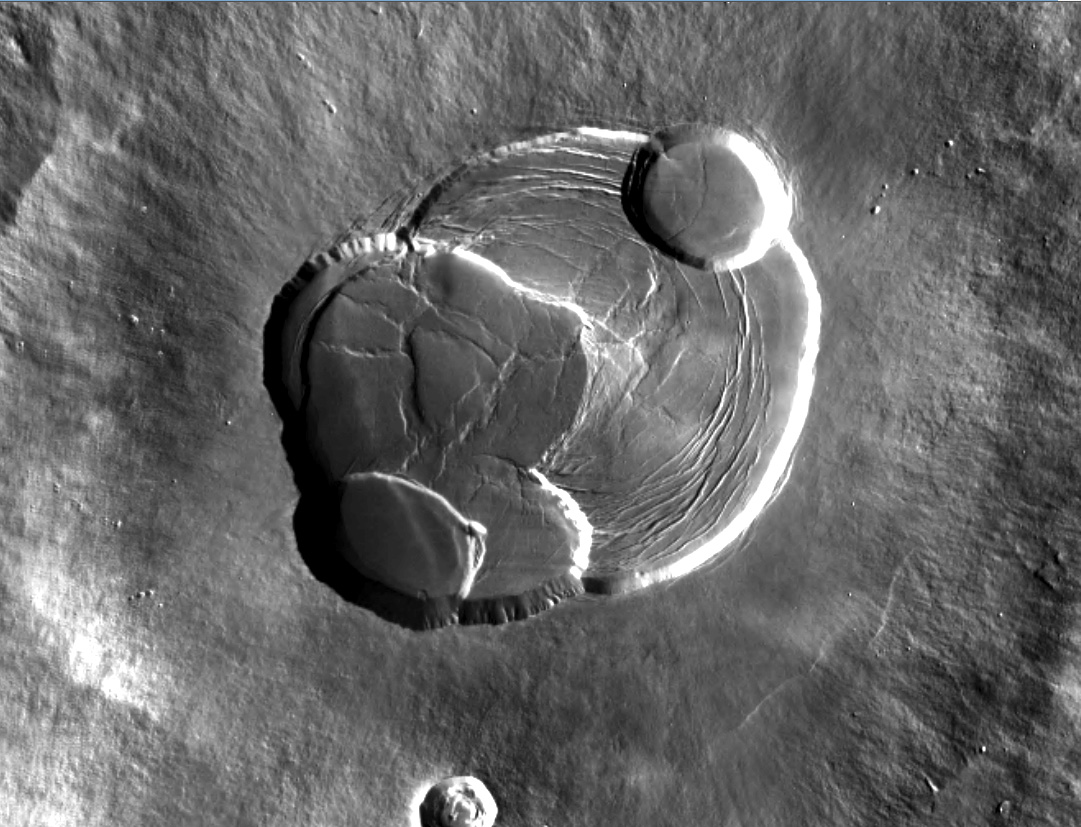
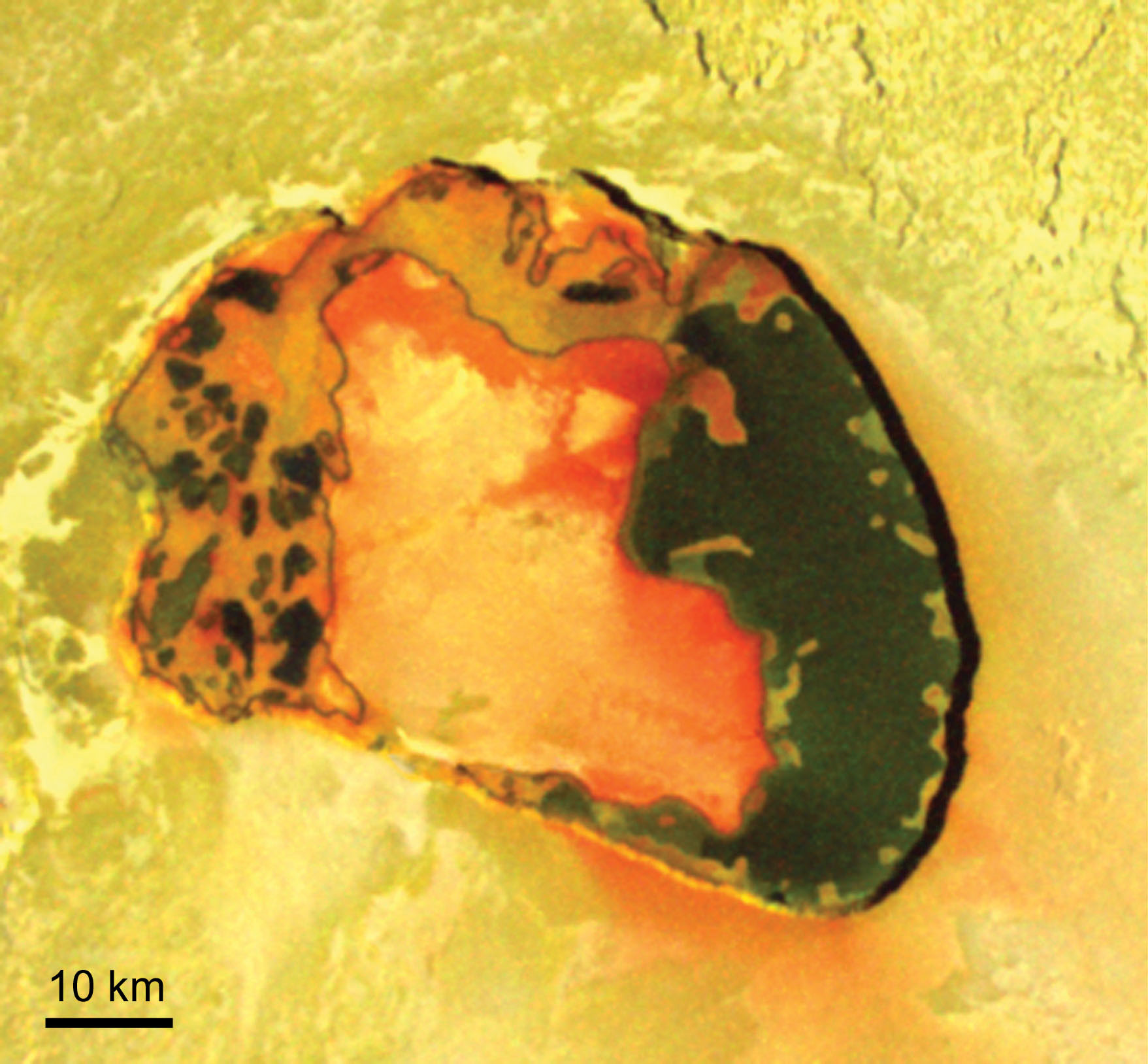
Pit craters
Pit craters are depressions smaller than calderas, which are formed by the rupture of a cavity created below the surface. They are distinguished from impact craters by the fact that they do not necessarily have a regular circular shape and do not have high rims. They can be created in many ways, such as by volcanic processes, when magma recedes, e.g. from a lava tunnel, ruptures a subsurface magma chamber, by seeding, when extension creates a cavity below the surface and it ruptures, or by the escape of volatile substances (gases) from the subsurface, karst dissolution, etc. The English name for non-volcanic cavities is usually pit, and those related to volcanism are called pit crater. Pit craters can occur individually, but pit crater chains (pit crater chain, geographically called catena) are typical in extension trenches, which e.g. they are formed above terranes or lava tunnels.
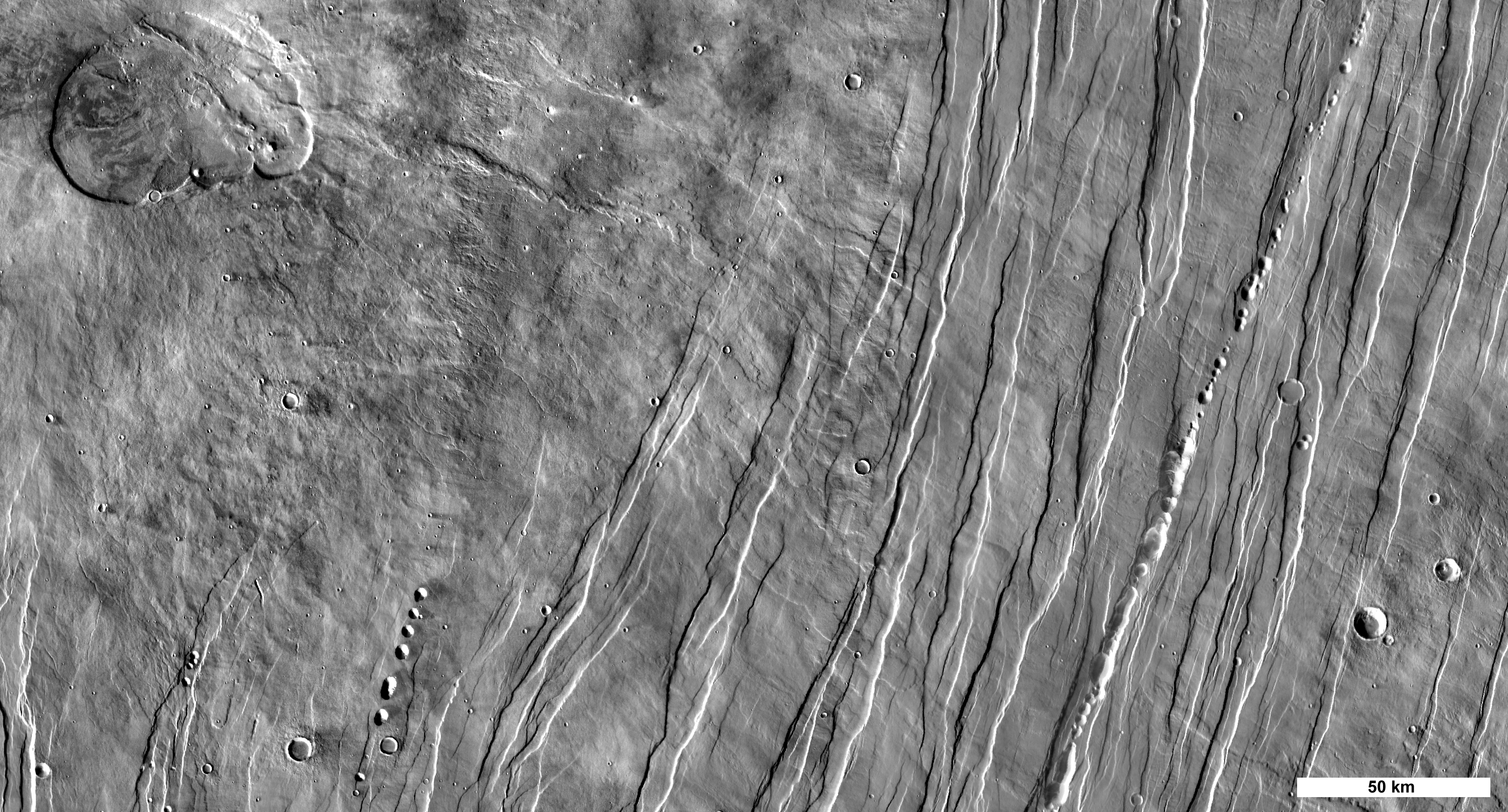
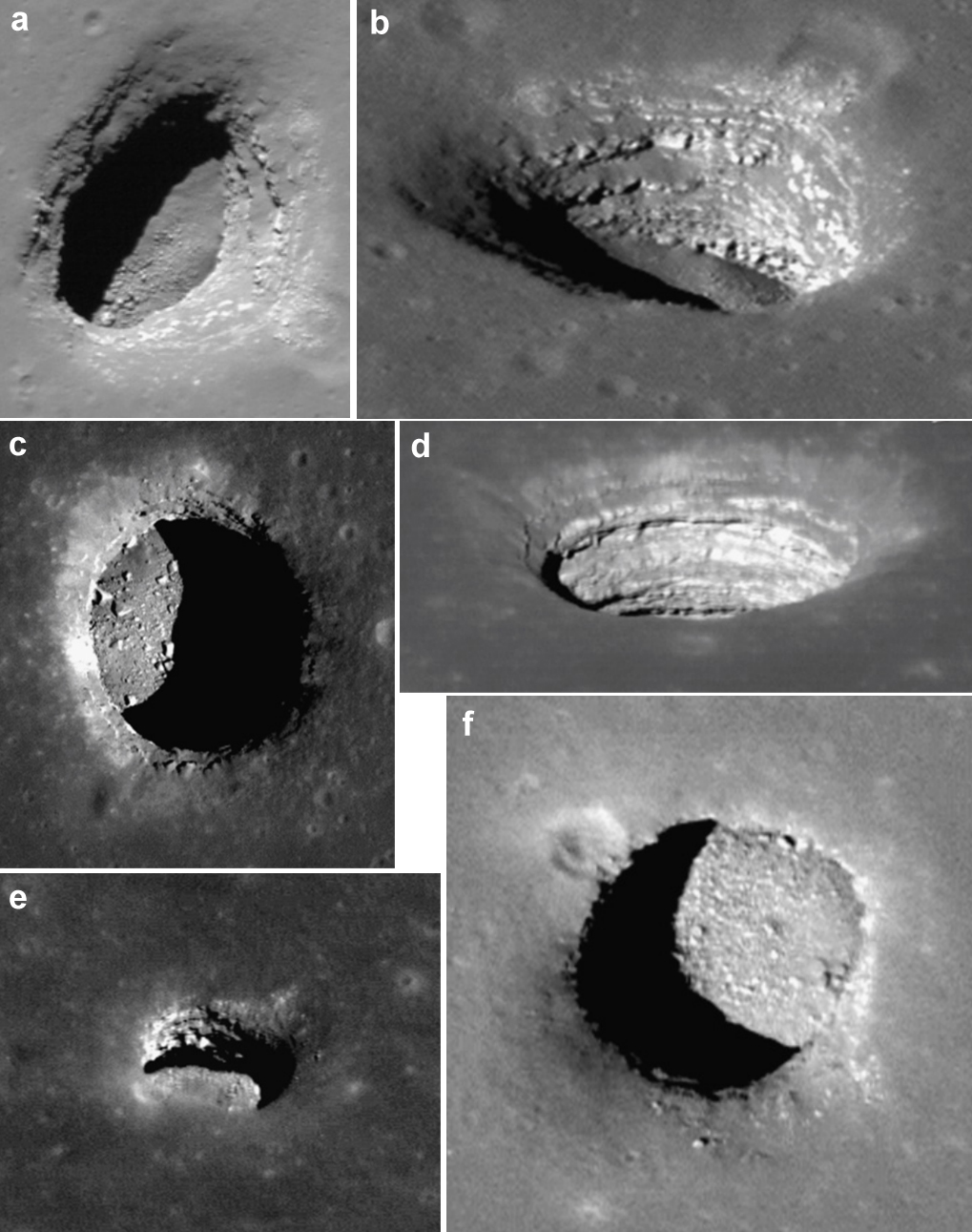
A series of pit craters can merge into a continuous depression or trench. Particularly interesting are the caves and lava-chasing structures (skylights) revealed by breaking off the top of the lava tunnels (Bérczi et al. 2010). It is possible that pits found on the slopes of large volcanoes on Mars or on the Moon lead to such lava tunnels. In this case, they can represent an entrance to well-used protected cavities during later expeditions; and on Mars they can even be a refuge for life. However, there can also be simple broken cavities that do not connect to a more extensive tunnel.
Subaqueous and subglacial volcanism and their landforms
Tuya and tindar, i.e. subglacial volcanoes, could have occurred on Mars, if the assumptions are correct that there were polar ice caps on Mars during the Hesperian period that were much more extensive than today, and that they partially melted due to volcanic thermal effects (Fastook et al. 2012).
Volcanotectonic forms (Venus)
There are several shapes on Venus that have no counterpart in any known celestial body. They were presumably created as a result of volcanic, magmatic and tectonic processes. It can be assumed that plate tectonics somehow prevents their creation on Earth, and perhaps similar structures could have formed on the early Earth (Lopez et al. 1999). The crowns (in geographical name: corona), of which approx. 500 have been catalogued, usually round or oval shapes with a diameter of 200-300 km, bounded by concentric tectonic trenches, a prominent rim and a trench behind it. The interior can be raised flat, vaulted, flat or sunken. There may be a radial trench system (nova) inside, which, however, can also be found independently of the crown. Starting from the crowns, lava flows are often found, and many smaller volcanic cones are also found.
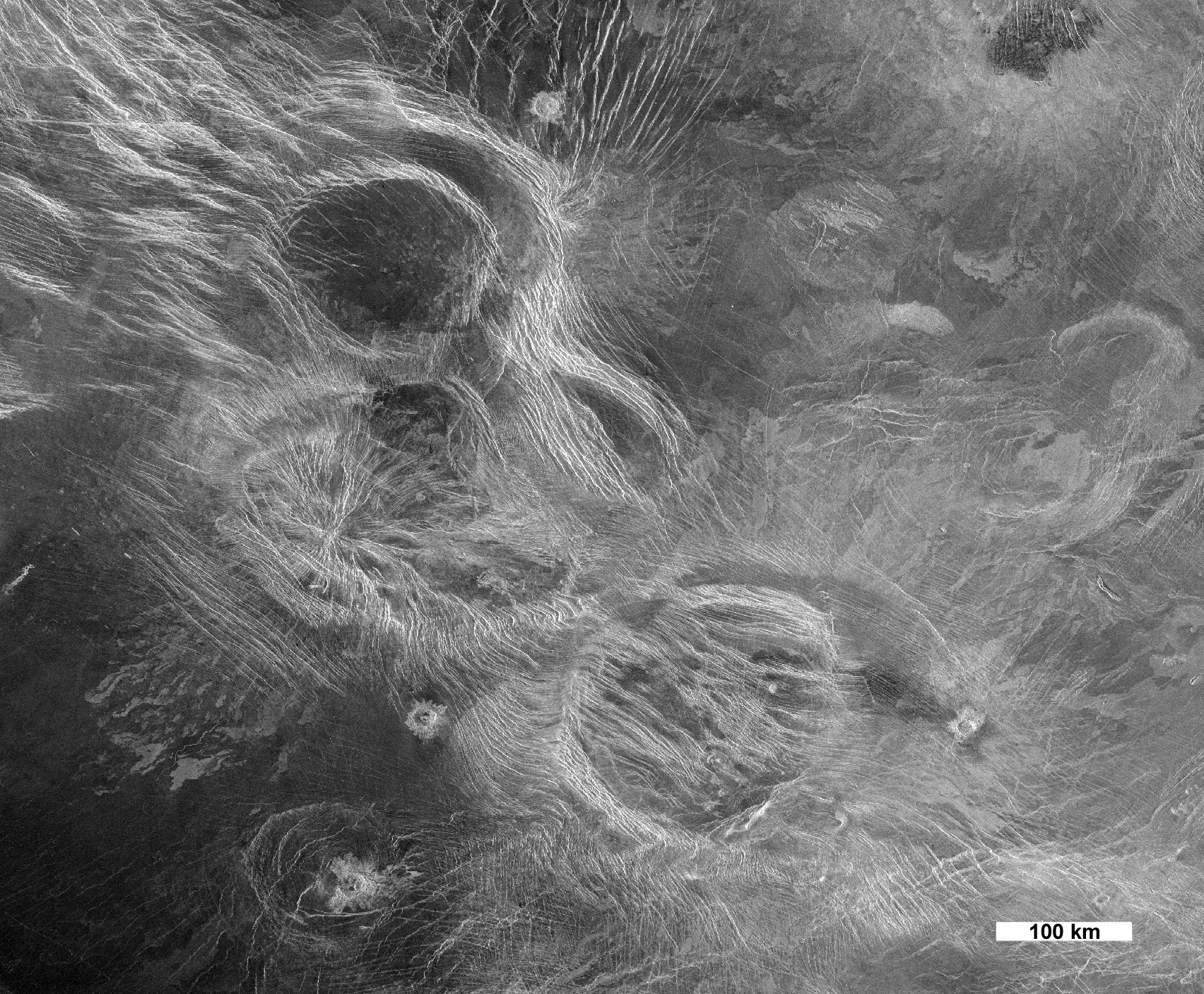
There are many explanations for their formation. According to the most popular one, they are created above a hot spot (mantle plume), which raises the crust, which later sinks back and the material of the crust relaxes. Crowns with different internal reliefs may show different stages of this process. According to another theory, material flows to the surface in a central volcanic source area, which is subducted in a tectonic trench on the edge of the crown. This was developed primarily for the largest corona, Artemis Corona, and is also referred to as soft plate tectonics.
Novas are arching areas from which a radial trench system spreads. The uplift is explained by mantle diapir and spill volcanism, and the cracks by the formation of a terrane system.
Lava flows
On the surface of other celestial bodies, the landscape is usually dominated by two types of topography: an ancient, varied surface densely dotted with craters or flat, barely cratered plains. The latter can usually be identified as the superimposed layers of poorly flowing lapel lava flows and can be classified as river basalts and plateau basalts. Globally, they occur inside large impact basins on Venus, Mercury and the Moon (where mare is their name). Some of them are lava plains with wrinkle ridges: thick wrinkles, which were probably wrinkled as a result of compressive forces along thrust faults, due to the weight of the lava, or as a result of its cooling or retreating compression or mantle flows. The cooling and uniform contraction of the spilled lava in all directions can also form polygonal patterns in the lava plains, such as those seen on Venus and Mercury. It is not certain that the giant Martian polygons were formed in lava, but quite a few surface types interpreted as lava flows show small-scale polygonal divisions with a diameter of one meter to ten meters, and on some of them a spiral pattern (coil) created by shearing forces in the lava flow can also be observed (Ryan and Christensen 2012).
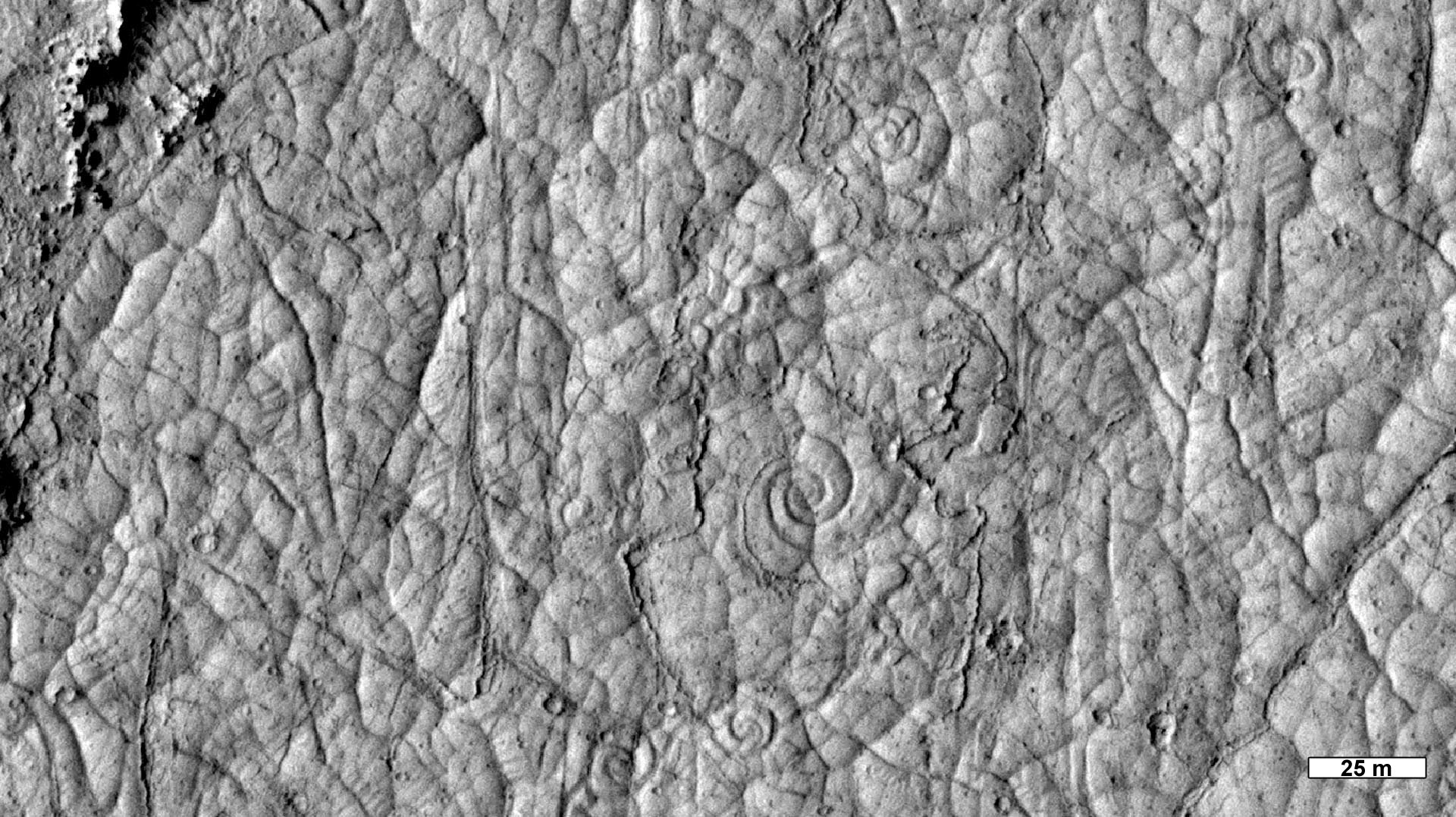
The origin of the featureless, smooth plains, free from any kind of modification (cracks, craters, creases, cones), is usually explained by the fact that these are the youngest lava plains. They are also found on Mars and Venus. Both Venus and Mars are characterized by lava flows divided by flow lobes, where the source of the lava flows can be easily identified, usually a volcanic cone or fissure.
Lava channels
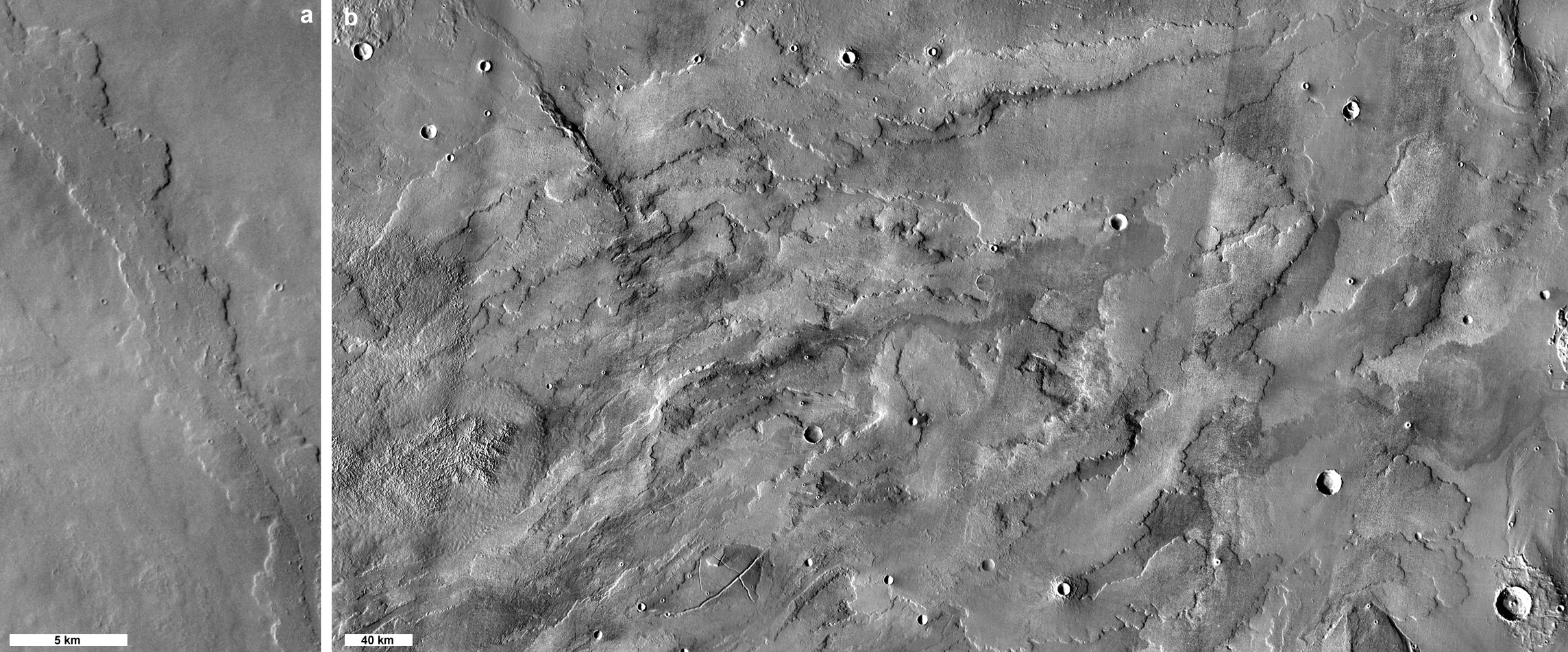
A special form of lava flow is lava flow confined to the channel, which can be created either by building a lava dam on both sides of the channel or by cutting into the surface material. The latter can be caused by mechanical or thermal erosion (melting of the surface) or by the combined effect of both.
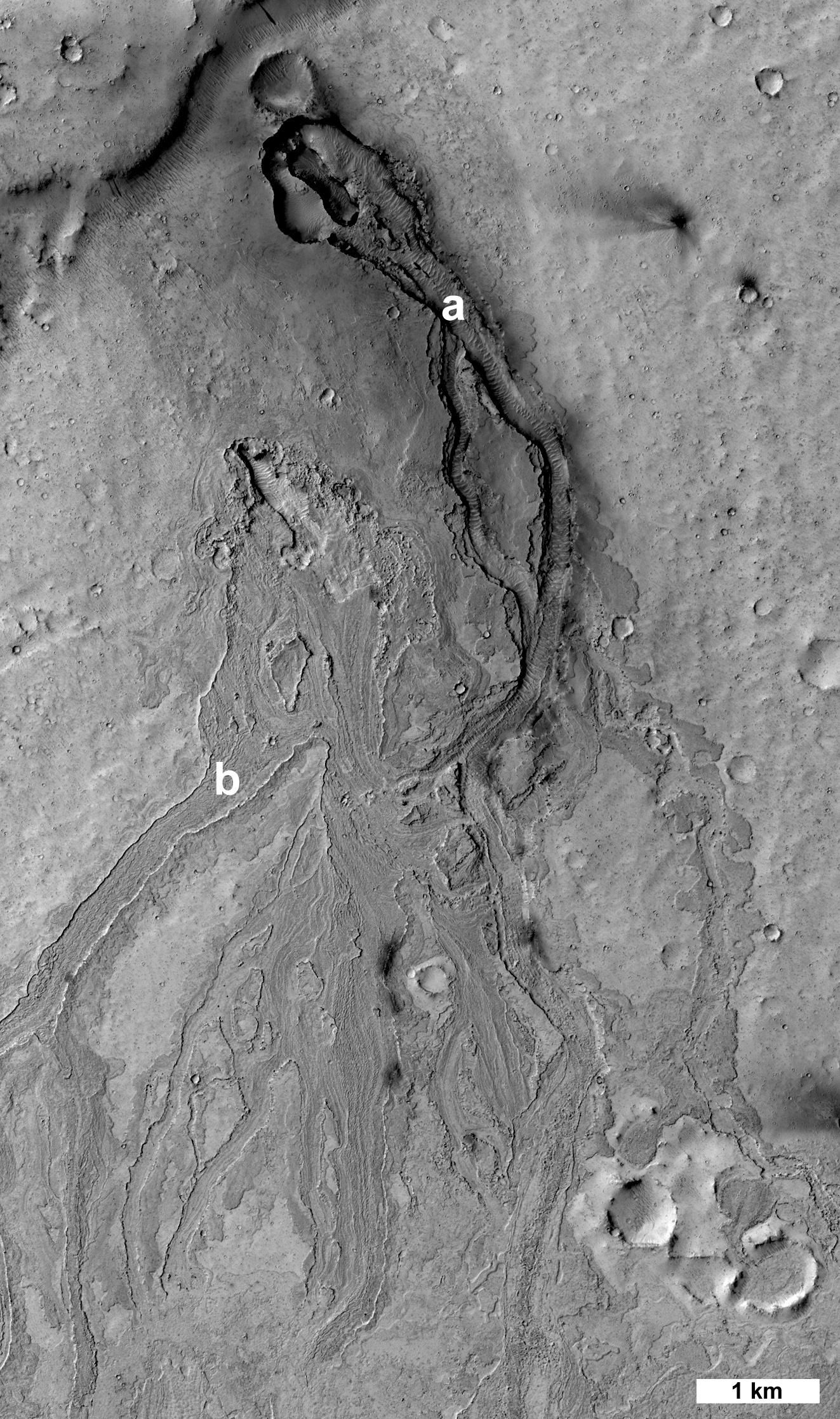
Lava channels usually meander like terrestrial river valleys, some meander, can split into branches, and others can form terraces so that a second, smaller channel cuts into the first, larger channel. It is no coincidence that the meandering valleys that can be observed on the Moon with binoculars have long been treated as evidence of lunar water. However, it is still not clear whether these canals really originated as surface canals or were created by the breaking of long sections of lava tunnels. A part of some channels seems to continue in a tunnel, which is also indicated by the broken ceiling in places along the line of the channel's continuation. The winding lava channels are called sinuous rille on the Moon and canali on Venus (Komatsu et al. 1992). While lava channels usually end near their source and flow within or through some lobular lava flow, Venusian lava flows travel far from their source region and meander across the Venusian plains for thousands of km. This may be because, in addition to lava flows being an excellent way to transport hot lava far without much heat loss, Venus' surface temperature of 500 degrees and the extreme surface density of its atmosphere further help the lava stay liquid for a long time; this can be contributed to by the thinly flowing nature of the lava and the provision of an adequate amount of supply. It is also conceivable that the lava channels on Venus are lava tunnels created under the surface that melted the surface from below.
Pyroclastic deposits
Pyroclastites of eruption cloud origin, accumulated by fall, occur on several celestial bodies.
Inside several large craters on the Moon, there are ditches that are interrupted by pit craters, and around these craters you can see a dark deposit, probably the fallback material of previous eruptions (dark halo pit). A similar but lighter deposit of material surrounds various calderas on Io and Mercury. Dark mantle deposits of irregular shape can be found in several places on the Moon, the material of which contains small glass spheres based on the samples of Apollo-15 and 17. These were probably formed in Hawaiian-type lava fountains. The stormy arrival of the magma to the surface could have been greatly helped by the fact that while the magma rose to the surface through the vents, it underwent extremely intense bubbling when it reached the nearly 0 air pressure lunar surface. Thus, the magma escaped with great pressure and covered a large area. However, in one place (south of Mare Orientale) there is an approx. A dark ring with a diameter of 150 km, at the center of which is an approx. There is a 15 km long elongated depression. According to the assumption, it is a particularly high-energy sediment from a single eruption, which, according to model calculations, is an approx. It fell back from a 40 km high eruption cloud sometime between 1.9 and 3.5 billion years ago.
However, similar eruption clouds can still be observed on Ion. Two types of eruption clouds on Io have been identified: Prometheus-type eruption clouds for high-temperature hot spots rising 50-150 km high and (by human standards) operating continuously for a long time, or eruptions associated with silicate lava lakes; they typically create a yellowish scatter ring around the volcanic center. Pele-type eruption clouds reach a height of 300-500 km and are intermittent; they typically produce a reddish scattering ring.
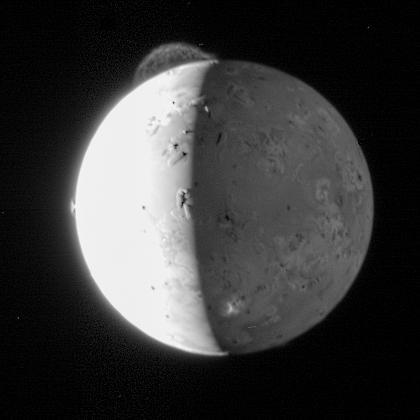
it is ejected from Tvashtar Patera and its material falls back forming a ring more than 1000 km in diameter. Another eruption cloud is visible on the edge of the planet (left): the 60 km high cloud of the continuously active Prometheus. Towards the south, the eruption cloud of the Masubi volcano erupting from the night near the day-night boundary is illuminated by the light of the Sun. The dark (night) side of Io is made visible by the light of Jupiter. New Horizons image, 2007 PIA09248 (NASA/Johns Hopkins University Applied Physics Laboratory/Southwest Research Institute)
References
Szaniszló Bérczi, Henrik Hargitai, Emese Homolya, Erzsébet Illés, Ákos Kereszturi, Mária Mörtl, András Sik, Péter Tasnádi, Tamás Weidinger (2010): Small Atlas of the Solar System (13) Fluids in the Solar System. Space Research Group Budapest.
Szaniszló Bérczi, Henrik Hargitai, Ákos Kereszturi, András Sik, (2001): Little Atlas of the Solar System (3) Atlas of Planetary Bodies. Space Research Group Budapest.
Bradak B, Kereszturi A (2003) Mud volcanism as a model for various planetary surface processes. 34th Lunar and Planetary Science Conference, #1304.
Bradak B, Kereszturi Á (2002) Application of mud volcanism for rocky and icy planetary bodies. 34th COSPAR Scientific Assembly, The Second World Space Congress, Houston.
Breuer D, Moore WB (2007) Dynamics and Thermal History of the Terrestrial Planets, the Moon, and Io. In: Spohn T (ed) Planets and Moons. Volume 10, Treatise on Geophysics. Elsevier.
Brož P, Hauber E (2012a) A unique volcanic field in Tharsis, Mars: Pyroclastic cones as evidence for explosive eruptions. Icarus 218, pp. 88–99.
Davies AG (2007) Volcanism on Io – A Comparison with Earth. Cambridge University Press, 372 pages.
Elkins-Tanton LT (2012) Magma Oceans in the Inner Solar System. Annual Review of Earth and Planetary Sciences 40; 113-139
Fastook JL, Head JW, Marchant D R, Forget F, Madeleine J-B (2012) Early Mars Climate Near the Noachian-Hesperian Boundary: Independent Evidence for Cold Conditions from Basal Melting of the South Polar Ice Sheet (Dorsa Argentea Formation) and Implications for Valley Network Formation. Icarus 219; 25-40
Geissler PE (2000) Cryovolcanism in the outer solar system. In: Sigurdsson H (ed.), Encyclopedia of Volcanoes, Academic, San Diego, 785-800.
Guest JE, Stofan ER (1999) A New View of the Stratigraphic History of Venus. Icarus139, 55–66
Hand KP, Chyba CF, Priscu JC, Carlson RW, Nealson KH (2009) Astrobiology and the potential for life on Europa. In: Pappalardo R, McKinnon W, Khurana K (eds): Europa. University of Arizona Press, Tucson, AZ.
Erzsébet Illés: Moons in the Solar System. Meteor Astronomy Yearbook 2006 pp. 194-227.
Illés E (2001) Comparative planetology. Outline of the series of lectures given in the special college of the Astronomy Department of ELTE TTK in the second semester of 1996/1997, 1998/1999 and 2000/2001 (manuscript)
Ivanov MA, Head JW (2011) Global geological map of Venus. Planetary and Space Science 59 1559–1600
Kereszturi Á (1995) The last voyage of Magellan, Meteor 25. 1995/6., 13-18.
Kereszturi Á (2000) Volcanism of Mars. Meteor 2000/6, 13.
Kereszturi Á (2006) Chapters from the evolution history of Mars. Hungarian Science 2006/8, 946.
Kereszturi A (2011) Astrobiology. Hungarian Astronomical Association, Budapest
Kereszturi A (2012) Mars - a white paper on the red planet. Hungarian Astronomical Association, Budapest
Komatsu G, Kargel JS, Baker VR (1992) Canali-type channels on Venus: Some genetic constraints. Geophys. Gap. Lett., 19, 1415-1418.
Lang NP (2009) Another Look at the Summit Caldera of Apollinaris Patera. 40th LPSC #2370.
Lopes RMC, Mitchell KL, Williams D, Mitri G (2010) Beyond Earth: How extra-terrestrial volcanism has changed our definition of a volcano. in: Cañón-Tapia E, Szakács A (eds): What is a volcano? GSA Special Papers 470, 11-30, doi: 10.1130/2010.2470(02)
Lopez I, Marguez A, Oyarzun R (1999) Are coronae restricted to Venus? Earth Moon and Planets 77:125-137.
Mouginis-Mark P.J., Rowland, S.K. (2001). The geomorphology of planetary calderas. Geomorphology, 37 201–223.
Pappalardo RT et al. (1999) Does Europa have a subsurface ocean?: evaluation of the geological evidence. Journal of Geophysical Research E Planets 104: 24015-24055.
Pappalardo RT, Head JW (1999) Europa: Role of The Ductile Layer. LPSC XXX #1967.
Robinson MS, Ashley JW, Boyd AK, Wagner RV, Speyerer EJ, Hawke BR, Hiesinger H, van der Bogert CH (2012) Confirmation of sublunar voids and thin layering in mare deposits. Planetary and Space Science 69 (1), 18-27.
Ryan AJ, Christensen PR (2012) Coils and Polygonal Crust in the Athabasca Valles Region, Mars, as Evidence for a Volcanic History. Science 336, 449–452 DOI: 10.1126/science.1219437
Schenk PM, Wilson RR, Davies AG. (2004). Shield volcano topography and the rheology of lava flows on Io. Icarus, 169 98–110.
Tanaka KL, Scott DH, Greeley R, Guest JE (1986/7) Geological map of the polar, western and eastern equatorial regions of Mars (1:15,000,000), USGS.
Thomas RJ (2013) Identification of possible recent water/lava source vents in the Cerberus plains: Stratigraphic and crater count age constraints. J. Geophys. Gap. Planets, 118, 789–802, doi:10.1002/jgre.20071.
Werner SC (2009) The global Martian volcanic evolutionary history. Icarus 201, pp. 44–68.