E. Illés-Almár: Evolution of planetary bodies (PDF, 24.3 MB)
Handout for university students.


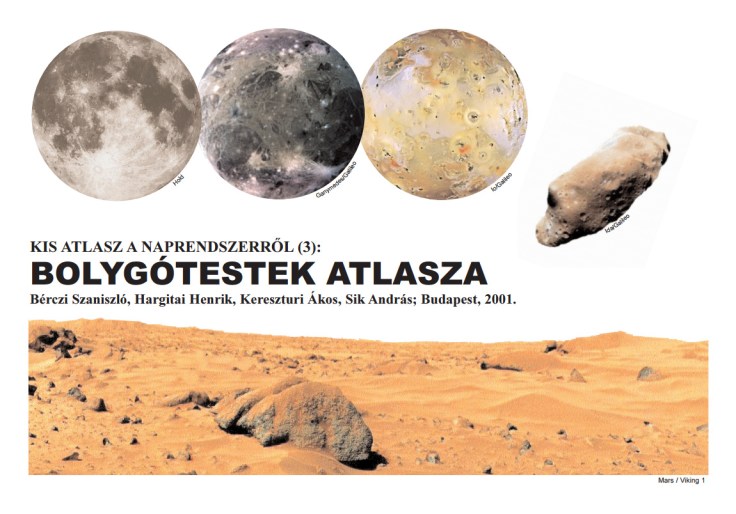
The surfaces of larger Solar System bodies as observed by spacecraft.
E. Illés-Almár: Evolution of planetary bodies (PDF, 24.3 MB)
Handout for university students.
Bérczi, Sz., Horváth, A., & Illés, E. (2003). Comparison of the Cracking and Fracturing Systems of Phobos and Europa. Sixth International Conference on Mars, #3198, 20-25 July, Pasadena, CD-ROM.
Bérczi, Sz., & Lukács, B. (1995). Attempt to Conjecture the Pattern of Alien Planetary Systems. 20th NIPR Symp. Antarctic Meteorites, Tokyo, Japan, p. 34.
Bérczi, Sz. (1995). Attempt to conjecture the pattern of Alien planetary systems [Presentation]. 20th NIPR Symposium Antarctic Meteorites, Tokyo, 1995 Jun. 8. 14.15.
Bérczi, Sz., & Lukács, B. (1994). Alien Planetary Systems. In B. Lukács, I. Kubovics, L. Stegena, & Sz. Bérczi (Eds.), Evolution of extraterrestrial materials and structures (MTA-KFKI-1994-22/C; pp. 6–28). MTA Központi Fizikai Kutatóintézet.
Bérczi, Sz., Detre, Cs., Don, Gy., Dosztály, L., Gucsik, A., Kiss, Á., & Solt, P. (1998). Interplanetary Stratigraphy of the Solar System. 17th IMA Conference, Toronto,. 1998 August.
Bérczi, Sz., & Lukács, B. (1998). Main Lines and Side Tracks in Basaltogenesis of Terrestrial Planetary Bodies. In B. Lukács & Sz. Bérczi (Eds.), Side tracks in evolution (MTA-KFKI-07/C; pp. 6–12). MTA Központi Fizikai Kutatóintézet.
Bérczi, Sz. (1980). Cyclicity in the Evolution of Matter and its Application to the Evolution of the Solar System. Acta Geologica Acad. Sci. Hung., 23(1-4), 163–171.
Bérczi, Sz. (1978). Cyclicity in the Evolution of Matter and its Application to the Evolution of the Solar System [Presentation]. Cyclicity: Theory and Practice Conference, Budapest, 1978, November.
Bérczi, Sz., Hargitai, H., Kereszturi, Á., & Sik, A. (2005). Concise Atlas on the Solar System (3): Atlas of Planetary Bodies. ELTE TTK Kozmikus Anyagokat Vizsgáló Űrkutató Csoport. Budapest.
Hargitai, H., Bérczi, Sz., Kereszturi, Á., Opitz, A., Sik, A., Weidinger, T., Tepliczky, I., & Bradák, B. (2003). Outreach activity of the planetology group of Eötvös University, Hungary: Experimental programs and experiences. In Lunar and planetary science (Abstract 1547). Lunar and Planetary Institute.
Raorane, A., Brasser, R., Matsumura, S., Lau, T., Lee, M. H., & Bouvier, A. (2025). Giant Planet Formation in the Solar System. EPSC-DPS Joint Meeting 2025, Helsinki, Finland, abstract #EPSC-DPS2025-155.
Computer simulations explore how the Solar System's giant planets could grow within the early gas and dust disk. The model gives different formation times for Jupiter, Saturn and the ice giants, and tests which conditions most strongly affect growth. Source
Bernabò, L. M., & Csizmadia, S. (2022). Planetary interiors via Love numbers determined from radial velocities. COSPAR, abstract #568.
Carrión-González, Ó., García, M. A., Santos, N. C., Cabrera, J., Csizmadia, S., & Rauer, H. (2021). A catalogue of up to 26 known exoplanets accessible to reflected-starlight observations with the Roman Space Telescope. EPSC, abstract #EPSC2021-772.
The researchers identify known exoplanets that Roman's planned instrument could observe in reflected starlight. Their catalog accounts for orbital uncertainties and helps prioritize targets and observing times. Source
Boldog, Á., Dobos, V., & Barr, A. C. (2021). Modeling the interiors of rocky exoplanets in the habitable zone. EPSC, abstract #EPSC2021-474.
Carrión-González, Ó., García, M. A., Santos, N. C., Cabrera, J., Csizmadia, S., & Rauer, H. (2021). Reflected-starlight phase curves: an observing strategy to constrain the radius and atmospheric properties of directly imaged exoplanets. EPSC, abstract #EPSC2021-694.
The study compares modeled exoplanet observations made at different viewing angles. Combining these measurements can help separate effects of planetary size and clouds, improving estimates of atmospheric composition. Source
Carrión-González, Ó., García, M. A., Cabrera, J., Csizmadia, S., Santos, N. C., & Rauer, H. (2020). Directly imaged exoplanets in reflected starlight. The importance of knowing the planet radius. EPSC, abstract #EPSC2020-674.
The paper investigates how reflected starlight can reveal an exoplanet's atmosphere. In the models, an unknown planetary radius allows several atmospheric explanations, making size constraints important for interpreting the observations. Source
Carrión-González, Ó., García, M. A., Cabrera, J., Csizmadia, S., & Santos, N. (2019). Direct imaging of cold exoplanets. A theory framework for atmospheric characterization. EPSC-DPS Joint Meeting, abstract #EPSC-DPS2019-1462.
Hellard, H., Csizmadia, S., & Rauer, H. (2019). Retrieval of the fluid Love number k2 in transit light curves: a feasibility study. EPSC, abstract #EPSC-DPS2019-137.
Padovan, S., Breuer, D., Csizmadia, S., Hugo, H., Rauer, H., Sohl, F., & Spohn, T. (2018). Fluid Love numbers with the matrix propagator method with an application to GJ436b. EPSC, abstract #EPSC2018-684.
Csizmadia, S., Hellard, H., & Smith, A. (2018). Interior structure of WASP-18b through its apsidal motion. EPSC, abstract #EPSC2018-858.
Hellard, H., Csizmadia, S., Padovan, S., Sohl, F., Breuer, D., Spohn, T., & Rauer, H. (2018). Measurability of the fluid Love number k2 in WASP-121b. EPSC, abstract #EPSC2018-310.
Futó, Péter (2017). BD+20594b:A mega-Earth detected in the C4 field of the Kepler K2 Mission.. LPSC, abstract #1078.
Futó, Péter (2016). Earth-like interior structure models for the transiting terrestrial exoplanets: Kepler-78b and Kepler-93b.. LPSC, abstract #1018.
Futó, Péter (2015). A transiting 'mega-Earth' in the Kepler-field: Kepler-10c.. LPSC, abstract #1024.
Simon, A., Szabó M., G., & Kiss, L. L. (2014). Detection limit for the size of exomoons around Kepler planetary candidates and in simulated CHEOPS data. EPSC, abstract #EPSC2014-584.
Futó, Péter (2014). Structural modeling for the low-mass transiting exoplanets: Kepler-70 b and Kepler-70 c.. LPSC, abstract #1045.
Futó, Péter (2013). Kepler- 36 b: A transiting super-Earth with an Earth-like interior structure.. LPSC, abstract #1552.
Csizmadia, S., Pasternacki, T., & Bordé, P. (2011). A homogeneous analysis of the transit light curves of the CoRoT exoplanets. EPSC-DPS Joint Meeting, abstract #1362.
Pál, A., Borkovits, T., & Szakáts, R. (2011). Multiple transiting extrasolar planetary systems - follow-up and Kepler discoveries. EPSC-DPS Joint Meeting, abstract #EPSC-DPS2011-1387.
Cabrera, J., Rauer, H., Erikson, A., & Csizmadia, S. (2011). The Transit Detection Algorithm DST and its application to CoRoT and Kepler data. EPSC, abstract #EPSC-DPS2011-1033.
Kisvárdai, I., & Kereszturi, Á. (2025). Improving Porosity Calculation Methods and Proposing a New Model Universally Applicable to Large- and Medium-sized Planetary Objects. Astrophysical Journal, 986(2), 217. https://doi.org/10.3847/1538-4357/add723
The authors combine two earlier approaches to improve estimates of pore space inside planetary bodies. They apply the new model to Earth, Mars, the Moon and Enceladus, exploring how pore space varies with depth and temperature. Source
Kisvárdai, I., Pál, B., & Kereszturi, Á. (2023). Investigating the porosity of Enceladus. Monthly Notices of The Royal Astronomical Society, 525(1), 1246–1253. https://doi.org/10.1093/mnras/stad2333
The researchers estimate the amount of pore space inside Saturn's moon Enceladus using several models. These spaces may matter for water circulation and water–rock interactions; the estimates come from calculations rather than direct measurements of the interior. Source
Márkusné Bebesi, Z., & Juhász, A. (2021). Effects of upstream conditions on ULF waves and SLAMS formation at Saturn. EGU, abstract #EGU21-5987.
André, N., Génot, V., Opitz, A., Cecconi, B., Achilleos, N., Guio, P., Milillo, A., Mura, A., Futaana, Y., & Hess, S. (2020). Sun Planet Interactions Digital Environment on Request (SPIDER) for Europlanet RI H2024. EPSC, abstract #EPSC2020-256.
SPIDER supports modeling of planetary and spacecraft environments, including their interactions with solar wind. Its proposed on-request simulations and databases help researchers analyze observations and prepare missions. Source
Hellard, H., Csizmadia, S., Smith, A., & Rauer, H. (2019). A method for direct testing of hydrostatic equilibrium in exopanet interiors. EPSC, abstract #EPSC-DPS2019-222-1.
Kuslits, L., Wesztergom, V., Prácser, E., & Lemperger, I. (2018). On the possibility of assessing processes in planetary dynamos based on the recunstruction of current density distribution using a combined machine learning - genetic algorithm inversion approach. EGU, abstract #EGU2018-14429.
Carlyle, J., Van Driel Gesztelyi, L., Zuccarello, F., James, A., & Williams, D. (2017). The 2015 St Patrick's Day Storm: Origins. DPS, abstract #404.02.
Márkusné Bebesi, Z., Erdős, G., & Szegő, K. (2016). Charged particle tracking at Titan, and further applications. EGU, abstract #EPSC2016-7348.
Cochran, W. D., Endl, M., Johnson, M. C., Lee, B., Park, C., Han, I., Rauer, H., Cabrera, J., Csizmadia, S., Paetzold, M., Yong, D., Asplund, M., & Hatzes, A. P. (2015). PICK2: Planets in Clusters with K2. DPS, abstract #417.02.
Varga, T., Szabó M., G., & Simon, A. (2014). Constraining the Orbital Alignment of KOI-1152.01: A Short Period Transiting Companion with High Obliquity and Eccentric Orbit. LPSC, abstract #2603.
Tóth, Z., & Nagy, I. (2014). Constraints on the Dynamical Stability of a Planet in the Habitable Zone of the Star Gliese 581. LPSC, abstract #1489.
Verebélyi, E., Kiss, C., Balog, Z., & Stansberry, J. (2014). Structure of the zodiacal emission by Spitzer archive data. ACM, abstract #576.
Márkusné Bebesi, Z., Erdős, G., Szegő, K., Juhász, A., & Lukács, K. (2014). Time-reversed particle dynamics calculation with field line tracing at Titan - an update. EGU, abstract #12093.
Márkusné Bebesi, Z., Erdős, G., Szegő, K., & Young, D. T. (2013). Time reversed test particle calculations at Titan, based on CAPS-IMS measurements. EGU, abstract #EGU2013-9637.
Márkusné Bebesi, Z., Szegő, K., Krupp, N., Németh, Z., Erdős, G., Crary, F., Mitchell, D., & Krimigis, S. (2012). On the structure of Titan's tail. EGU, abstract #EGU2012-5515.
Andriopoulou, M., Roussos, E., Krupp, N., Kollmann, P., Márkusné Bebesi, Z., Paranicas, C., & Thomsen, M. (2011). A statistical study of the energetic electron microsignatures from Tethys and Dione. EPSC-DPS Joint Meeting, abstract #211.
Futó, P., & Gucsik, A. (2011). Coreless Earth-mass exomoon of an EGP. LPSC, abstract #abstract# 1229.
Futó, Péter (2010). Detailed internal structure model for Super-Earths in case of Earth-like composition.. LPSC, abstract #1024.
Márkusné Bebesi, Z., Krupp, N., Szegő, K., Németh, Z., Erdős, G., Fraenz, M., Krimigis, S. M., Mitchell, D. G., Young, D. T., & Dougherty, M. K. (2010). Distribution of high energy electron drop-outs in the upper atmosphere of Titan. AGU, abstract #SM11C-1765.
Márkusné Bebesi, Z., Krupp, N., Fraenz, M., Krimigis, S., Mitchell, D., Szegő, K., Erdős, G., Németh, Z., & Young, D. (2010). Energetic electron absorption in the upper atmosphere of Titan. COSPAR, abstract #10.
Kenneth, H., Zieger, B., Xianzhe, J., & Tamas, G. (2010). Saturn’s Current Sheet Structure as a Function of SolarWind Dynamic Pressure and Season (Axial Tilt). EGU, abstract #EGU2010-14150.
Földi, T., Bérczi, Sz., & Palásti, E. (2001). Water and bacteria transport via electrostatic coagulation and their accumulation at the poles on a dusty planet. 32nd Lunar and Planetary Science Conference (Abstract No. 1059). Lunar and Planetary Institute.
Timár, A., Opitz, A., Biró, N., Dálya, Z., Kobán, G., Németh, Z., & Madár, Á. (2022). Temporal evolution and spatial variation of the solar wind structures throughout the heliosphere. EPSC, abstract #EPSC2022-993.
Measurements from multiple spacecraft track how interaction regions between fast and slow solar-wind streams travel and evolve. The aim is to improve forecasts of conditions at planets and spacecraft while reducing false alarms. Source
Németh, Z., Szegő, K., Timár, A., Földy, L., Burch, J., & Goldstein, R. (2020). Determining the ion velocity in the inner magnetosphere of comet 67P/Churyumov–Gerasimenko using Rosetta IES measurements. EGU, abstract #EGU2020-3347.
The study estimates the original speeds of charged particles around comet 67P from Rosetta measurements. It models and corrects how the spacecraft's electrical potential distorts particles' motion before they reach the instruments. Source
Márkusné Bebesi, Z., Erdős, G., Dósa, M., Juhász, A., & Szegő, K. (2020). Observations of Short Large Amplitude Magnetic Structures at the Kronian bow shock. EPSC, abstract #EPSC2020-251.
Cassini observed brief, strong magnetic structures upstream of Saturn that alter incoming solar-wind particles. The paper compares their slowing, heating and reflection effects with similar phenomena near Earth. Source
Dósa, M., Mangano, V., Milillo, A., Massetti, S., Márkusné Bebesi, Z., & Timár, A. (2020). Space weather at Mercury as observed by the THEMIS telescope from Earth. EGU, abstract #EGU2020-7143.
Dósa, M., Mangano, V., Márkusné Bebesi, Z., Massetti, S., Milillo, A., & Görgei, A. (2020). THEMIS telescope images analysed for space weather traces. EPSC, abstract #1022.
The study compares telescope images of sodium emission around Mercury with solar-wind data. It investigates how solar activity affects material released from the surface, while the limited observations leave the relationship uncertain. Source
Boldog, Á., Dobos, V., & Kiss, L. L. (2019). Magnetospheric properties of the TRAPPIST-1 planets. EPSC, abstract #EPSC-DPS2019-1403.
Timár, A., Németh, Z., Szegő, K., & Pierre, H. (2019). Understanding the structure of the fading magnetosphere around comet 67P/Churyumov-Gerasimenko using measurements from the last weeks of the Rosetta mission.. EGU, abstract #EGU2019-17369.
Németh, Zoltán (2018). A revised theory of the diamagnetic cavity of comets. EPSC, abstract #EPSC2018-1059.
Németh, Z., Szegő, K., & Cowley, S. (2018). Giant closed field line vortices in the nightside magnetosphere of Saturn. EGU, abstract #EGU2018-14620.
Opitz, A., Szabo, K., Dálya, Z., Timár, A., Dósa, M., Németh, Z., Szegő, K., & Andre, N. (2018). Validity of planetary space weather predictions. EPSC, abstract #EPSC2018-918.
Hajra, R., Henri, P., Vallières, X., Gilet, N., Moré, J., Goetz, C., Richter, I., Glassmeier, K., Galand, M. F., Heritier, K. L., Eriksson, A. I., Németh, Z., Tsurutani, B. T., Rubin, M., & Altwegg, K. (2017). Diamagnetic cavity at comet 67P/Churyumov-Gerasimenko: plasma characteristics and dynamics. EGU, abstract #EGU2017-5278.
Németh, Z., Dósa, M., Goetz, C., Madanian, H., Opitz, A., Richter, K., Szegő, K., & Timár, A. (2017). Estimating the solar wind pressure at comet 67P from Rosetta magnetic field measurements. EPSC, abstract #EPSC2017-612-2.
Dósa, M., Opitz, A., Németh, Z., & Szegő, K. (2017). Magnetic lasso: a new solar wind propagation method and its application concerning space weather at 67P/CG. EPSC, abstract #EPSC2017-635.
Madanian, H., Cravens, T., Burch, J., Goldstein, R., Rubin, M., Németh, Z., Goetz, C., Koenders, C., Glassmeier, K., & Altwegg, K. (2017). Plasma Environment around Comet 67P/Churyumov-Gerasimenko at its Perihelion Observed by the Rosetta RPC-IES Sensors. EGU, abstract #EGU2017-10156.
Opitz, A., Szegő, K., Dálya, Z., Timár, A., Németh, Z., Dósa, M., Vech, D., & Andre, N. (2017). Validity and reliability of space weather predictions at Venus, Mars and Comet 67P. EPSC, abstract #EPSC2017-631.
Németh, Z., Burch, J., Goetz, C., Glassmeier, K., Goldstein, R., Koenders, C., Madanian, H., Mandt, K., Mokashi, P., Richter, I., Szegő, K., & Timár, A. (2016). Finding diamagnetic cavity crossing events at comet 67P/Churyumov-Gerasimenko using multiple instruments of the Rosetta Plasma Consortium. EGU, abstract #EGU2016-14195.
Vech, D., Stenberg, G., Nilsson, H., Edberg, N., Opitz, A., Szegő, K., Zhang, T., & Futaana, Y. (2016). On the global polarity reversal of the induced magnetosphere of Venus: a statistical study. EGU, abstract #EGU2016-116-1.
Henri, P., Vallières, X., Gilet, N., Hajra, R., Moré, J., Goetz, C., Richter, I., Glassmeier, K., Galand, M., Heritier, K., Eriksson, A. I., Németh, Z., Tsurutani, B., Rubin, M., & Altwegg, K. (2016). Structure and dynamics of the umagnetized plasma around comet 67P/CG. AGU, abstract #P43A-2095.
Opitz, A., Vech, D., Sanchez-Diaz, E., Witasse, O., Szegő, K., & Opgenoorth, H. (2015). ICME effects on the induced magnetospheres of Venus and Mars. EGU, abstract #11900.
Henri, P., Eriksson, A., Edberg, N., Béghin, C., Décréau, P., Grard, R., Hamelin, M., Johansson, E., Lebreton, J., Mazelle, C., Odelstad, E., Randriamboarison, O., Schmidt, W., Wattieaux, G., Winterhalter, D., Vallières, X., Vigren, E., Glassmeier, K. H., Goetz, C., …, Schwartz, S. J. (2015). Mapping of the cometary plasma density around comet CG/67P at perihelion.. AGU, abstract #P31E-2112.
Vech, D., Szegő, K., Opitz, A., Kajdic, P., Fraenz, M., Kallio, E., & Alho, M. (2015). Planetary space weather effects on the bow shock, the magnetic barrier and the ion composition boundary at Venus. EGU, abstract #EGU2015-288-4.
Vech, D., Stenberg, G., Nilsson, H., Edberg, N. J. T., Opitz, A., Szegő, K., Zhang, T. L., & Futaana, Y. (2015). The effects of IMF sector boundary crossings on the induced magnetosphere of Venus. EPSC, abstract #EPSC2015-26.
Opitz, A., Vech, D., Sanchez-Diaz, E., Szegő, K., Witasse, O., & Andre, N. (2015). Validity of space weather prediction to Venus and Mars. EPSC, abstract #EPSC2015-90.
Opitz, A., Witasse, O., Szegő, K., Vech, D., & Opgenoorth, H. (2014). Solar storm effects on the induced magnetospheres of Venus and Mars. EPSC, abstract #EPSC2014-667.
Németh, Z., Szegő, K., Lukács, K., & Erdős, G. (2014). The effect of magnetic field fluctuations on the initial distribution of pick-up ions. EPSC, abstract #EPSC2014-552.
Szegő, K., Németh, Z., Földy, L., Cowley, S. W. H., & Provan, G. (2013). Dual periodicities in the flapping of Saturn’s magnetodisk. EGU, abstract #EGU2013-4444.
Németh, Z., Szegő, K., Földy, L., Kivelson, M., Jia, X., Ramer, K., Cowley, S. W., & Provan, G. (2013). Periodic modulation of ion velocities within the magnetodisk of Saturn. EGU, abstract #EGU2013-5121-1.
Németh, Z., Szegő, K., Földy, L., Kivelson, M. G., Jia, X., Ramer, K. M., Cowley, S. W. H., Provan, G., & Thomsen, M. (2013). Velocity moments in the outer nightside magnetodisk of Saturn. EPSC, abstract #EPSC2013-480.
Coates, A. J., Wellbrock, A., Lewis, G. R., Crary, F. J., Thomsen, M. F., Reisenfeld, D. B., Szegő, K., Márkusné Bebesi, Z., Arridge, C. S., Jones, G. H., Sittler, E. C. J., & Johnson, R. E. (2012). Cassini in Titan's tail: CAPS observations of plasma escape. EGU, abstract #EGU2012-8433.
Vörös, Z., Facskó, G. I., Khodachenko, M. L., Runov, A., Janhunen, P., & Palmroth, M. (2012). Distant magnetotail dynamics of Earth-like planetary magnetospheres. EPSC, abstract #EPSC2012-199.
Szegő, K., Németh, Z., Márkusné Bebesi, Z., Földy, L., Erdős, G., Thomsen, M., & Delapp, D. (2012). Exploration of the magnetodisk of Saturn around equinox. EGU, abstract #EGU2012-7628.
Márkusné Bebesi, Z., Szegő, K., Németh, Z., Erdős, G., Coates, A., & Young, D. (2012). Investigation of Titan's ion environment during plasmasheet type encounters. EPSC, abstract #EPSC2012-647.
Szegő, K., Németh, Z., Erdős, G., Földy, L., Márkusné Bebesi, Z., Thomsen, M., & Delapp, D. (2012). Location of the magnetodisk in the outer magnetosphere of Saturn based on ion densities. EPSC, abstract #EPSC2012-72.
Opitz, Andrea (2012). Solar wind structures and their effects on the plasma environment of Earth and Mars. EGU, abstract #EGU2012-12604.
Németh, Z., Szegő, K., Márkusné Bebesi, Z., Erdős, G., & Földy, L. (2012). The shape of the magnetodisk of Saturn-as revealed by in situ measurements. EGU, abstract #EGU2012-7901.
Németh, Z., Szegő, K., Erdős, G., Földy, L., & Márkusné Bebesi, Z. (2011). A kinetic model of the magnetodisk of Saturn. EPSC, abstract #EPSC-DPS2011-443.
Németh, Z., Szegő, K., Földy, L., Erdős, G., Thomsen, M., & Delapp, D. (2011). Modulation of the Ion Moments by the SKR Periodicity in the Outer Magnetosphere of Saturn. AGU, abstract #SM11A-2006.
Opitz, A., Fedorov, A., Wurz, P., Sauvaud, J., & Luhmann, J. G. (2011). Prediction of solar wind structures between Venus and Mars orbits. AGU, abstract #SH22A-06.
Lai, H., Russell, C. T., Delzanno, G., Opitz, A., & Luhmann, J. G. (2010). Interplanetary Field Enhancements: Dusty plasmas formed by meteoroid collisions in the solar wind. AGU, abstract #SH51D-1710.
Brandt, P., Mitchell, D., Paranicas, C., Khurana, K., Zieger, B., Hansen, K., Carbary, J., & Krimigis, S. (2010). Is periodic plasmoid release the driver of periodic phenomena in Saturn's magnetosphere. EGU, abstract #EGU2010-10068-1.
Bertucci, C., Neubauer, F. M., Ma, Y., Wei, H., Dougherty, M. K., Wahlund, J., Szegő, K., Crary, F. J., & Mitchell, D. G. (2010). Magnetic convection and diffusion within Titan's induced magnetosphere: the case of flybys T39 and T70 (Invited). AGU, abstract #6.
Roussos, E., Krupp, N., Kollmann, P., Paranicas, C., Mitchell, D. G., Krimigis, S. M., Müller, A. L., & Márkusné Bebesi, Z. (2010). Organizing energetic particle fluxes in Saturn's inner magnetosphere. EPSC, abstract #412.
Szegő, K., Németh, Z., Erdős, G., Földy, L., Thomsen, M., & Delapp, D. (2010). Saturn’s plasma sheet properties near Titan encounters as derived from ion densities measured by the Cassini/CAPS instrument. EPSC, abstract #EPSC2010-77.
Opitz, A., Wurz, P., Sauvaud, J., & Fedorov, A. (2010). Temporal evolution of the solar wind in the ecliptic between Venus and Mars orbits. EGU, abstract #EGU2010-3973.
Németh, Z., Szegő, K., Földy, L., Thomsen, M. F., Delapp, D., Coates, A. J., Wellbrock, A., & Márkusné Bebesi, Z. (2010). The Anatomy of Two Nightside Magnetodisk Crossings near Titan. AGU, abstract #SM11C-1759.
Szegő, K., Németh, Z., Erdős, G., Földy, L., Thomsen, M. F., & Delapp, D. (2010). The plasma environment of the magnetodisk of Saturn near Titan encounters as derived from ion densities measured by the Cassini/CAPS instrument. AGU, abstract #SM11C-1758.
Bérczi Szaniszló: Beszámoló a 2005. márciusi, 36-ik LPSC konferenciáról
Bérczi Sz. Hargitai H., Kereszturi Á., Sik A.: Kis Atlasz a Naprendszerr?l (3): Bolygótestek atlasza. UNICONSTANT, Püspökladány (ISBN 963 00 6314 XÖ, 963 00 8474 0)