E. Illés-Almár: Evolution of planetary bodies (PDF, 24,3 MB)
Egyetemi hallgatóknak készült jegyzet.


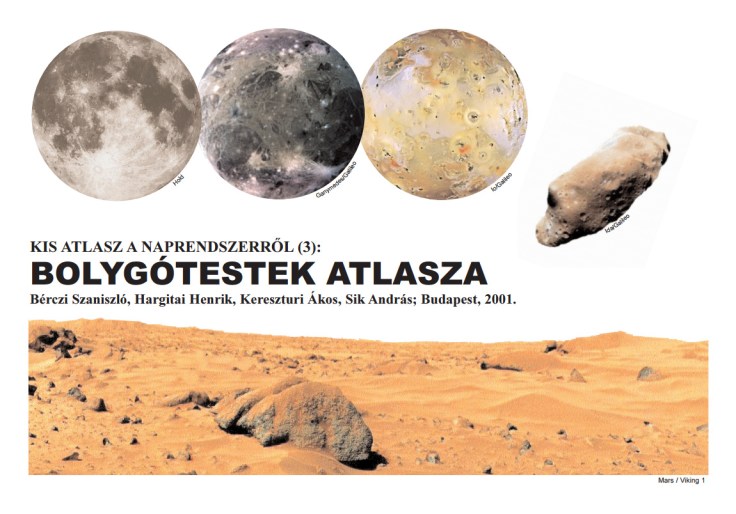
A Naprendszer nagyobb égitesteinek űrszondákról megfigyelhető felszínét mutatja be.
E. Illés-Almár: Evolution of planetary bodies (PDF, 24,3 MB)
Egyetemi hallgatóknak készült jegyzet.
Horváth, Zs., & Bérczi, Sz. (2013). Az exobolygók sokszínű világa. A fizika, matematika és művészet találkozása az oktatásban, kutatásban. Marosvásárhelyi Konferencia Közleményei. (Főszerk. Tél Tamás, Juhász András).
Bérczi, Sz., Horváth, A., & Illés, E. (2003). Comparison of the Cracking and Fracturing Systems of Phobos and Europa. Sixth International Conference on Mars, #3198, 20-25 July, Pasadena, CD-ROM.
Bérczi, Sz., & Lukács, B. (1995). Attempt to Conjecture the Pattern of Alien Planetary Systems. 20th NIPR Symp. Antarctic Meteorites, Tokyo, Japan, p. 34.
Bérczi, Sz. (1995). Attempt to conjecture the pattern of Alien planetary systems [Előadás]. 20th NIPR Symposium Antarctic Meteorites, Tokyo, 1995 Jun. 8. 14.15.
Bérczi, Sz., & Lukács, B. (1994). Alien Planetary Systems. In B. Lukács, I. Kubovics, L. Stegena, & Sz. Bérczi (Eds.), Evolution of extraterrestrial materials and structures (MTA-KFKI-1994-22/C; pp. 6–28). MTA Központi Fizikai Kutatóintézet.
Bérczi, Sz., & Lukács, B. (1992). A ritka földfémek földúsulása magmás folyamatokban: kozmikus (Naprendszerbeli) és földi összehasonlítás. A Magyar Tudományos Akadémia Agrártudományok Osztályának Tájékoztatója. 96-98.old. In A Magyar Tudományos Akadémia Agrártudományok Osztályának Tájékoztatója (pp. 96–98).
Bérczi, Sz., & Horváth, A. (2013). A „kőbölcsőtől” az éles kövek öbléig. Aeromagazin, 15, 48–51.
Bérczi, Sz. (2003). A Naprendszer keletkezésének kémiai modellje. Ásványi anyagok övezeteinek létrejötte a Naprendszerben. In E. Dudich (Ed.), Geonómia az ezredforduló után (pp. 35–40). MTA–UNICONSTANT.
Bérczi, Sz., Detre, Cs., Don, Gy., Dosztály, L., Gucsik, A., Kiss, Á., & Solt, P. (1998). Interplanetary Stratigraphy of the Solar System. 17th IMA Conference, Toronto,. 1998 augusztus.
Bérczi, Sz., & Lukács, B. (1998). Main Lines and Side Tracks in Basaltogenesis of Terrestrial Planetary Bodies. In B. Lukács & Sz. Bérczi (Eds.), Side tracks in evolution (MTA-KFKI-07/C; pp. 6–12). MTA Központi Fizikai Kutatóintézet.
Bérczi, Sz. (1980). Cyclicity in the Evolution of Matter and its Application to the Evolution of the Solar System. Acta Geologica Acad. Sci. Hung., 23(1-4), 163–171.
Bérczi, Sz. (1978). Cyclicity in the Evolution of Matter and its Application to the Evolution of the Solar System [Előadás]. Cyclicity: Theory and Practice Conference, Budapest, 1978, november.
Vizi, Zs., & Bérczi, Sz. (1976). Csillag és környezete. In L. Egyed (Ed.), A változó világegyetem I (pp. 91–103). Közgazdasági és Jogi Könyvkiadó.
Bérczi, Sz. (1976). Ősfelszín [Film vagy forgatókönyv]. Szakanyag és forgatókönyv. MAFILM.
Bérczi, Sz., Gucsik, A., Hargitai, H., Kereszturi, A., & Nagy, Sz. (2008). III. Planetológiai Szeminárium. ELTE TTK, Budapest, 2008, szeptember 4-5. (Az absztrakt kötet szerkesztése).
Bérczi, Sz. (2007). Kis atlasz sorozat a Naprendszerről. Fizikai Szemle, 57(3), 95–96.
Bérczi, Sz., Hargitai, H., Kereszturi, Á., & Sik, A. (2005). Concise Atlas on the Solar System (3): Atlas of Planetary Bodies. ELTE TTK Kozmikus Anyagokat Vizsgáló Űrkutató Csoport. Budapest.
Hargitai, H., Bérczi, Sz., Kereszturi, Á., Opitz, A., Sik, A., Weidinger, T., Tepliczky, I., & Bradák, B. (2003). Outreach activity of the planetology group of Eötvös University, Hungary: Experimental programs and experiences. In Lunar and planetary science (Abstract 1547). Lunar and Planetary Institute.
Bérczi, Sz., Hargitai, H., Kereszturi, Á., & Sik, A. (2001). Kis Atlasz a Naprendszerről (3): Bolygótestek atlasza. UNICONSTANT, Püspökladány.
Bérczi, Sz. (1989). Rendező elvek a planetológiában. Természet Világa, 120.(7), 290–298.
Bérczi, Sz. (1978). Planetológia. Egyetemi jegyzet, Tankönyvkiadó, Budapest (J3-1154).
MRT Tudósfórum, Kossuth, hétfő du. 3-4-ig.. A Naprendszer kutatása. 1999 nov. 8. (Almár, Illés, Bérczi) [Televíziós vagy rádiós szereplés].
TV. Egyetem . A Változó Világegyetem. 2 adás 1976 és 1977. ismétlés 1987 [Televíziós vagy rádiós szereplés].
Raorane, A., Brasser, R., Matsumura, S., Lau, T., Lee, M. H., & Bouvier, A. (2025). Giant Planet Formation in the Solar System. EPSC-DPS Joint Meeting 2025, Helsinki, Finland, abstract #EPSC-DPS2025-155.
Számítógépes szimulációkkal vizsgálják, hogyan nőhettek meg a Naprendszer óriásbolygói a korai gáz- és porkorongban. A modell eltérő kialakulási időket jelez a Jupiter, a Szaturnusz és a jégóriások számára, és teszteli, mely feltételek befolyásolják leginkább a növekedést. Forrás
Bernabò, L. M., & Csizmadia, S. (2022). Planetary interiors via Love numbers determined from radial velocities. COSPAR, abstract #568.
Carrión-González, Ó., García, M. A., Santos, N. C., Cabrera, J., Csizmadia, S., & Rauer, H. (2021). A catalogue of up to 26 known exoplanets accessible to reflected-starlight observations with the Roman Space Telescope. EPSC, abstract #EPSC2021-772.
Ismert exobolygók adataiból kiválasztják azokat, amelyeket a Roman űrtávcső tervezett műszere visszavert csillagfényben megfigyelhet. A pályák bizonytalanságát is figyelembe vevő katalógus a célpontok és a megfigyelési időpontok kiválasztását támogatja. Forrás
Boldog, Á., Dobos, V., & Barr, A. C. (2021). Modeling the interiors of rocky exoplanets in the habitable zone. EPSC, abstract #EPSC2021-474.
Carrión-González, Ó., García, M. A., Santos, N. C., Cabrera, J., Csizmadia, S., & Rauer, H. (2021). Reflected-starlight phase curves: an observing strategy to constrain the radius and atmospheric properties of directly imaged exoplanets. EPSC, abstract #EPSC2021-694.
Különböző megfigyelési helyzetekből származó visszavert fény mérését hasonlítják össze exobolygómodelleken. A több nézőpont segíthet elkülöníteni a bolygó méretének és a felhőknek a hatását, így pontosabban becsülhető a légkör összetétele. Forrás
Carrión-González, Ó., García, M. A., Cabrera, J., Csizmadia, S., Santos, N. C., & Rauer, H. (2020). Directly imaged exoplanets in reflected starlight. The importance of knowing the planet radius. EPSC, abstract #EPSC2020-674.
A tanulmány azt vizsgálja, mennyire lehet egy exobolygó légkörét a róla visszaverődő csillagfényből megismerni. A modellekben a bolygó ismeretlen mérete többféle légköri magyarázatot is megengedhet, ezért a sugár pontosabb ismerete fontos az értelmezéshez. Forrás
Carrión-González, Ó., García, M. A., Cabrera, J., Csizmadia, S., & Santos, N. (2019). Direct imaging of cold exoplanets. A theory framework for atmospheric characterization. EPSC-DPS Joint Meeting, abstract #EPSC-DPS2019-1462.
Hellard, H., Csizmadia, S., & Rauer, H. (2019). Retrieval of the fluid Love number k2 in transit light curves: a feasibility study. EPSC, abstract #EPSC-DPS2019-137.
Padovan, S., Breuer, D., Csizmadia, S., Hugo, H., Rauer, H., Sohl, F., & Spohn, T. (2018). Fluid Love numbers with the matrix propagator method with an application to GJ436b. EPSC, abstract #EPSC2018-684.
Csizmadia, S., Hellard, H., & Smith, A. (2018). Interior structure of WASP-18b through its apsidal motion. EPSC, abstract #EPSC2018-858.
Hellard, H., Csizmadia, S., Padovan, S., Sohl, F., Breuer, D., Spohn, T., & Rauer, H. (2018). Measurability of the fluid Love number k2 in WASP-121b. EPSC, abstract #EPSC2018-310.
Futó, Péter (2017). BD+20594b:A mega-Earth detected in the C4 field of the Kepler K2 Mission.. LPSC, abstract #1078.
Futó, Péter (2016). Earth-like interior structure models for the transiting terrestrial exoplanets: Kepler-78b and Kepler-93b.. LPSC, abstract #1018.
Futó, Péter (2015). A transiting 'mega-Earth' in the Kepler-field: Kepler-10c.. LPSC, abstract #1024.
Simon, A., Szabó M., G., & Kiss, L. L. (2014). Detection limit for the size of exomoons around Kepler planetary candidates and in simulated CHEOPS data. EPSC, abstract #EPSC2014-584.
Futó, Péter (2014). Structural modeling for the low-mass transiting exoplanets: Kepler-70 b and Kepler-70 c.. LPSC, abstract #1045.
Futó, Péter (2013). Kepler- 36 b: A transiting super-Earth with an Earth-like interior structure.. LPSC, abstract #1552.
Csizmadia, S., Pasternacki, T., & Bordé, P. (2011). A homogeneous analysis of the transit light curves of the CoRoT exoplanets. EPSC-DPS Joint Meeting, abstract #1362.
Pál, A., Borkovits, T., & Szakáts, R. (2011). Multiple transiting extrasolar planetary systems - follow-up and Kepler discoveries. EPSC-DPS Joint Meeting, abstract #EPSC-DPS2011-1387.
Cabrera, J., Rauer, H., Erikson, A., & Csizmadia, S. (2011). The Transit Detection Algorithm DST and its application to CoRoT and Kepler data. EPSC, abstract #EPSC-DPS2011-1033.
Kisvárdai, I., & Kereszturi, Á. (2025). Improving Porosity Calculation Methods and Proposing a New Model Universally Applicable to Large- and Medium-sized Planetary Objects. Astrophysical Journal, 986(2), 217. https://doi.org/10.3847/1538-4357/add723
A szerzők két korábbi megközelítést egyesítve javítják a bolygóbelsők üregeinek és pórusainak becslését. Az új modellt a Földre, a Marsra, a Holdra és az Enceladusra alkalmazzák, megvizsgálva, hogyan változik a pórustér a mélységgel és a hőmérséklettel. Forrás
Kisvárdai, I., Pál, B., & Kereszturi, Á. (2023). Investigating the porosity of Enceladus. Monthly Notices of The Royal Astronomical Society, 525(1), 1246–1253. https://doi.org/10.1093/mnras/stad2333
A Szaturnusz Enceladus holdjának belsejében levő pórusok mennyiségét becsülik különböző modellekkel. Ezek az üregek fontosak lehetnek a víz keringésében és a kőzetekkel való kölcsönhatásában; az eredmények számításokon, nem közvetlen belső méréseken alapulnak. Forrás
Márkusné Bebesi, Z., & Juhász, A. (2021). Effects of upstream conditions on ULF waves and SLAMS formation at Saturn. EGU, abstract #EGU21-5987.
André, N., Génot, V., Opitz, A., Cecconi, B., Achilleos, N., Guio, P., Milillo, A., Mura, A., Futaana, Y., & Hess, S. (2020). Sun Planet Interactions Digital Environment on Request (SPIDER) for Europlanet RI H2024. EPSC, abstract #EPSC2020-256.
A SPIDER szolgáltatás bolygók és űreszközök környezetének modellezését támogatja a napszél hatásának figyelembevételével. A javasolt, kérésre futtatható számítások és adatbázisok a kutatói elemzéseket és a küldetések előkészítését segítik. Forrás
Hellard, H., Csizmadia, S., Smith, A., & Rauer, H. (2019). A method for direct testing of hydrostatic equilibrium in exopanet interiors. EPSC, abstract #EPSC-DPS2019-222-1.
Kuslits, L., Wesztergom, V., Prácser, E., & Lemperger, I. (2018). On the possibility of assessing processes in planetary dynamos based on the recunstruction of current density distribution using a combined machine learning - genetic algorithm inversion approach. EGU, abstract #EGU2018-14429.
Carlyle, J., Van Driel Gesztelyi, L., Zuccarello, F., James, A., & Williams, D. (2017). The 2015 St Patrick's Day Storm: Origins. DPS, abstract #404.02.
Márkusné Bebesi, Z., Erdős, G., & Szegő, K. (2016). Charged particle tracking at Titan, and further applications. EGU, abstract #EPSC2016-7348.
Cochran, W. D., Endl, M., Johnson, M. C., Lee, B., Park, C., Han, I., Rauer, H., Cabrera, J., Csizmadia, S., Paetzold, M., Yong, D., Asplund, M., & Hatzes, A. P. (2015). PICK2: Planets in Clusters with K2. DPS, abstract #417.02.
Varga, T., Szabó M., G., & Simon, A. (2014). Constraining the Orbital Alignment of KOI-1152.01: A Short Period Transiting Companion with High Obliquity and Eccentric Orbit. LPSC, abstract #2603.
Tóth, Z., & Nagy, I. (2014). Constraints on the Dynamical Stability of a Planet in the Habitable Zone of the Star Gliese 581. LPSC, abstract #1489.
Verebélyi, E., Kiss, C., Balog, Z., & Stansberry, J. (2014). Structure of the zodiacal emission by Spitzer archive data. ACM, abstract #576.
Márkusné Bebesi, Z., Erdős, G., Szegő, K., Juhász, A., & Lukács, K. (2014). Time-reversed particle dynamics calculation with field line tracing at Titan - an update. EGU, abstract #12093.
Márkusné Bebesi, Z., Erdős, G., Szegő, K., & Young, D. T. (2013). Time reversed test particle calculations at Titan, based on CAPS-IMS measurements. EGU, abstract #EGU2013-9637.
Márkusné Bebesi, Z., Szegő, K., Krupp, N., Németh, Z., Erdős, G., Crary, F., Mitchell, D., & Krimigis, S. (2012). On the structure of Titan's tail. EGU, abstract #EGU2012-5515.
Andriopoulou, M., Roussos, E., Krupp, N., Kollmann, P., Márkusné Bebesi, Z., Paranicas, C., & Thomsen, M. (2011). A statistical study of the energetic electron microsignatures from Tethys and Dione. EPSC-DPS Joint Meeting, abstract #211.
Futó, P., & Gucsik, A. (2011). Coreless Earth-mass exomoon of an EGP. LPSC, abstract #abstract# 1229.
Futó, Péter (2010). Detailed internal structure model for Super-Earths in case of Earth-like composition.. LPSC, abstract #1024.
Márkusné Bebesi, Z., Krupp, N., Szegő, K., Németh, Z., Erdős, G., Fraenz, M., Krimigis, S. M., Mitchell, D. G., Young, D. T., & Dougherty, M. K. (2010). Distribution of high energy electron drop-outs in the upper atmosphere of Titan. AGU, abstract #SM11C-1765.
Márkusné Bebesi, Z., Krupp, N., Fraenz, M., Krimigis, S., Mitchell, D., Szegő, K., Erdős, G., Németh, Z., & Young, D. (2010). Energetic electron absorption in the upper atmosphere of Titan. COSPAR, abstract #10.
Kenneth, H., Zieger, B., Xianzhe, J., & Tamas, G. (2010). Saturn’s Current Sheet Structure as a Function of SolarWind Dynamic Pressure and Season (Axial Tilt). EGU, abstract #EGU2010-14150.
Bérczi Sz. Hargitai H., Kereszturi Á., Sik A.: Kis Atlasz a Naprendszerr?l (3): Bolygótestek atlasza. UNICONSTANT, Püspökladány (ISBN 963 00 6314 XÖ, 963 00 8474 0)
Földi, T., Bérczi, Sz., & Palásti, E. (2001). Water and bacteria transport via electrostatic coagulation and their accumulation at the poles on a dusty planet. 32nd Lunar and Planetary Science Conference (Abstract No. 1059). Lunar and Planetary Institute.
Timár, A., Opitz, A., Biró, N., Dálya, Z., Kobán, G., Németh, Z., & Madár, Á. (2022). Temporal evolution and spatial variation of the solar wind structures throughout the heliosphere. EPSC, abstract #EPSC2022-993.
Több űrszonda adataiból követik, hogyan haladnak és változnak a napszél gyors és lassú áramlásainak találkozási tartományai. A cél a bolygók és űreszközök környezetére készített előrejelzések javítása, a téves riasztások csökkentésével. Forrás
Németh, Z., Szegő, K., Timár, A., Földy, L., Burch, J., & Goldstein, R. (2020). Determining the ion velocity in the inner magnetosphere of comet 67P/Churyumov–Gerasimenko using Rosetta IES measurements. EGU, abstract #EGU2020-3347.
A Rosetta méréseiből a 67P üstökös körüli töltött részecskék eredeti sebességét becsülik. Ehhez modellezik és korrigálják, hogyan torzítja a szonda saját elektromos töltése a műszerekhez érkező részecskék mozgását. Forrás
Márkusné Bebesi, Z., Erdős, G., Dósa, M., Juhász, A., & Szegő, K. (2020). Observations of Short Large Amplitude Magnetic Structures at the Kronian bow shock. EPSC, abstract #EPSC2020-251.
A Cassini a Szaturnusz előtt olyan rövid, erős mágneses struktúrákat figyelt meg, amelyek megváltoztatják a beáramló napszél részecskéinek mozgását. A cikk a lassulást, felmelegedést és visszaverődést a Föld közelében ismert hasonló jelenségekkel hasonlítja össze. Forrás
Dósa, M., Mangano, V., Milillo, A., Massetti, S., Márkusné Bebesi, Z., & Timár, A. (2020). Space weather at Mercury as observed by the THEMIS telescope from Earth. EGU, abstract #EGU2020-7143.
Dósa, M., Mangano, V., Márkusné Bebesi, Z., Massetti, S., Milillo, A., & Görgei, A. (2020). THEMIS telescope images analysed for space weather traces. EPSC, abstract #1022.
A Merkúr ritka gázburkának nátriumfénylését földi távcsőfelvételeken vetik össze a napszél adataival. A cél annak tisztázása, hogyan befolyásolja a Nap a felszínről kiszabaduló anyagot; a kevés adat alapján az összefüggés még bizonytalan. Forrás
Boldog, Á., Dobos, V., & Kiss, L. L. (2019). Magnetospheric properties of the TRAPPIST-1 planets. EPSC, abstract #EPSC-DPS2019-1403.
Timár, A., Németh, Z., Szegő, K., & Pierre, H. (2019). Understanding the structure of the fading magnetosphere around comet 67P/Churyumov-Gerasimenko using measurements from the last weeks of the Rosetta mission.. EGU, abstract #EGU2019-17369.
Németh, Zoltán (2018). A revised theory of the diamagnetic cavity of comets. EPSC, abstract #EPSC2018-1059.
Németh, Z., Szegő, K., & Cowley, S. (2018). Giant closed field line vortices in the nightside magnetosphere of Saturn. EGU, abstract #EGU2018-14620.
Opitz, A., Szabo, K., Dálya, Z., Timár, A., Dósa, M., Németh, Z., Szegő, K., & Andre, N. (2018). Validity of planetary space weather predictions. EPSC, abstract #EPSC2018-918.
Hajra, R., Henri, P., Vallières, X., Gilet, N., Moré, J., Goetz, C., Richter, I., Glassmeier, K., Galand, M. F., Heritier, K. L., Eriksson, A. I., Németh, Z., Tsurutani, B. T., Rubin, M., & Altwegg, K. (2017). Diamagnetic cavity at comet 67P/Churyumov-Gerasimenko: plasma characteristics and dynamics. EGU, abstract #EGU2017-5278.
Németh, Z., Dósa, M., Goetz, C., Madanian, H., Opitz, A., Richter, K., Szegő, K., & Timár, A. (2017). Estimating the solar wind pressure at comet 67P from Rosetta magnetic field measurements. EPSC, abstract #EPSC2017-612-2.
Dósa, M., Opitz, A., Németh, Z., & Szegő, K. (2017). Magnetic lasso: a new solar wind propagation method and its application concerning space weather at 67P/CG. EPSC, abstract #EPSC2017-635.
Madanian, H., Cravens, T., Burch, J., Goldstein, R., Rubin, M., Németh, Z., Goetz, C., Koenders, C., Glassmeier, K., & Altwegg, K. (2017). Plasma Environment around Comet 67P/Churyumov-Gerasimenko at its Perihelion Observed by the Rosetta RPC-IES Sensors. EGU, abstract #EGU2017-10156.
Opitz, A., Szegő, K., Dálya, Z., Timár, A., Németh, Z., Dósa, M., Vech, D., & Andre, N. (2017). Validity and reliability of space weather predictions at Venus, Mars and Comet 67P. EPSC, abstract #EPSC2017-631.
Németh, Z., Burch, J., Goetz, C., Glassmeier, K., Goldstein, R., Koenders, C., Madanian, H., Mandt, K., Mokashi, P., Richter, I., Szegő, K., & Timár, A. (2016). Finding diamagnetic cavity crossing events at comet 67P/Churyumov-Gerasimenko using multiple instruments of the Rosetta Plasma Consortium. EGU, abstract #EGU2016-14195.
Vech, D., Stenberg, G., Nilsson, H., Edberg, N., Opitz, A., Szegő, K., Zhang, T., & Futaana, Y. (2016). On the global polarity reversal of the induced magnetosphere of Venus: a statistical study. EGU, abstract #EGU2016-116-1.
Henri, P., Vallières, X., Gilet, N., Hajra, R., Moré, J., Goetz, C., Richter, I., Glassmeier, K., Galand, M., Heritier, K., Eriksson, A. I., Németh, Z., Tsurutani, B., Rubin, M., & Altwegg, K. (2016). Structure and dynamics of the umagnetized plasma around comet 67P/CG. AGU, abstract #P43A-2095.
Opitz, A., Vech, D., Sanchez-Diaz, E., Witasse, O., Szegő, K., & Opgenoorth, H. (2015). ICME effects on the induced magnetospheres of Venus and Mars. EGU, abstract #11900.
Henri, P., Eriksson, A., Edberg, N., Béghin, C., Décréau, P., Grard, R., Hamelin, M., Johansson, E., Lebreton, J., Mazelle, C., Odelstad, E., Randriamboarison, O., Schmidt, W., Wattieaux, G., Winterhalter, D., Vallières, X., Vigren, E., Glassmeier, K. H., Goetz, C., …, Schwartz, S. J. (2015). Mapping of the cometary plasma density around comet CG/67P at perihelion.. AGU, abstract #P31E-2112.
Vech, D., Szegő, K., Opitz, A., Kajdic, P., Fraenz, M., Kallio, E., & Alho, M. (2015). Planetary space weather effects on the bow shock, the magnetic barrier and the ion composition boundary at Venus. EGU, abstract #EGU2015-288-4.
Vech, D., Stenberg, G., Nilsson, H., Edberg, N. J. T., Opitz, A., Szegő, K., Zhang, T. L., & Futaana, Y. (2015). The effects of IMF sector boundary crossings on the induced magnetosphere of Venus. EPSC, abstract #EPSC2015-26.
Opitz, A., Vech, D., Sanchez-Diaz, E., Szegő, K., Witasse, O., & Andre, N. (2015). Validity of space weather prediction to Venus and Mars. EPSC, abstract #EPSC2015-90.
Opitz, A., Witasse, O., Szegő, K., Vech, D., & Opgenoorth, H. (2014). Solar storm effects on the induced magnetospheres of Venus and Mars. EPSC, abstract #EPSC2014-667.
Németh, Z., Szegő, K., Lukács, K., & Erdős, G. (2014). The effect of magnetic field fluctuations on the initial distribution of pick-up ions. EPSC, abstract #EPSC2014-552.
Szegő, K., Németh, Z., Földy, L., Cowley, S. W. H., & Provan, G. (2013). Dual periodicities in the flapping of Saturn’s magnetodisk. EGU, abstract #EGU2013-4444.
Németh, Z., Szegő, K., Földy, L., Kivelson, M., Jia, X., Ramer, K., Cowley, S. W., & Provan, G. (2013). Periodic modulation of ion velocities within the magnetodisk of Saturn. EGU, abstract #EGU2013-5121-1.
Németh, Z., Szegő, K., Földy, L., Kivelson, M. G., Jia, X., Ramer, K. M., Cowley, S. W. H., Provan, G., & Thomsen, M. (2013). Velocity moments in the outer nightside magnetodisk of Saturn. EPSC, abstract #EPSC2013-480.
Coates, A. J., Wellbrock, A., Lewis, G. R., Crary, F. J., Thomsen, M. F., Reisenfeld, D. B., Szegő, K., Márkusné Bebesi, Z., Arridge, C. S., Jones, G. H., Sittler, E. C. J., & Johnson, R. E. (2012). Cassini in Titan's tail: CAPS observations of plasma escape. EGU, abstract #EGU2012-8433.
Vörös, Z., Facskó, G. I., Khodachenko, M. L., Runov, A., Janhunen, P., & Palmroth, M. (2012). Distant magnetotail dynamics of Earth-like planetary magnetospheres. EPSC, abstract #EPSC2012-199.
Szegő, K., Németh, Z., Márkusné Bebesi, Z., Földy, L., Erdős, G., Thomsen, M., & Delapp, D. (2012). Exploration of the magnetodisk of Saturn around equinox. EGU, abstract #EGU2012-7628.
Márkusné Bebesi, Z., Szegő, K., Németh, Z., Erdős, G., Coates, A., & Young, D. (2012). Investigation of Titan's ion environment during plasmasheet type encounters. EPSC, abstract #EPSC2012-647.
Szegő, K., Németh, Z., Erdős, G., Földy, L., Márkusné Bebesi, Z., Thomsen, M., & Delapp, D. (2012). Location of the magnetodisk in the outer magnetosphere of Saturn based on ion densities. EPSC, abstract #EPSC2012-72.
Opitz, Andrea (2012). Solar wind structures and their effects on the plasma environment of Earth and Mars. EGU, abstract #EGU2012-12604.
Németh, Z., Szegő, K., Márkusné Bebesi, Z., Erdős, G., & Földy, L. (2012). The shape of the magnetodisk of Saturn-as revealed by in situ measurements. EGU, abstract #EGU2012-7901.
Németh, Z., Szegő, K., Erdős, G., Földy, L., & Márkusné Bebesi, Z. (2011). A kinetic model of the magnetodisk of Saturn. EPSC, abstract #EPSC-DPS2011-443.
Németh, Z., Szegő, K., Földy, L., Erdős, G., Thomsen, M., & Delapp, D. (2011). Modulation of the Ion Moments by the SKR Periodicity in the Outer Magnetosphere of Saturn. AGU, abstract #SM11A-2006.
Opitz, A., Fedorov, A., Wurz, P., Sauvaud, J., & Luhmann, J. G. (2011). Prediction of solar wind structures between Venus and Mars orbits. AGU, abstract #SH22A-06.
Lai, H., Russell, C. T., Delzanno, G., Opitz, A., & Luhmann, J. G. (2010). Interplanetary Field Enhancements: Dusty plasmas formed by meteoroid collisions in the solar wind. AGU, abstract #SH51D-1710.
Brandt, P., Mitchell, D., Paranicas, C., Khurana, K., Zieger, B., Hansen, K., Carbary, J., & Krimigis, S. (2010). Is periodic plasmoid release the driver of periodic phenomena in Saturn's magnetosphere. EGU, abstract #EGU2010-10068-1.
Bertucci, C., Neubauer, F. M., Ma, Y., Wei, H., Dougherty, M. K., Wahlund, J., Szegő, K., Crary, F. J., & Mitchell, D. G. (2010). Magnetic convection and diffusion within Titan's induced magnetosphere: the case of flybys T39 and T70 (Invited). AGU, abstract #6.
Roussos, E., Krupp, N., Kollmann, P., Paranicas, C., Mitchell, D. G., Krimigis, S. M., Müller, A. L., & Márkusné Bebesi, Z. (2010). Organizing energetic particle fluxes in Saturn's inner magnetosphere. EPSC, abstract #412.
Szegő, K., Németh, Z., Erdős, G., Földy, L., Thomsen, M., & Delapp, D. (2010). Saturn’s plasma sheet properties near Titan encounters as derived from ion densities measured by the Cassini/CAPS instrument. EPSC, abstract #EPSC2010-77.
Opitz, A., Wurz, P., Sauvaud, J., & Fedorov, A. (2010). Temporal evolution of the solar wind in the ecliptic between Venus and Mars orbits. EGU, abstract #EGU2010-3973.
Németh, Z., Szegő, K., Földy, L., Thomsen, M. F., Delapp, D., Coates, A. J., Wellbrock, A., & Márkusné Bebesi, Z. (2010). The Anatomy of Two Nightside Magnetodisk Crossings near Titan. AGU, abstract #SM11C-1759.
Szegő, K., Németh, Z., Erdős, G., Földy, L., Thomsen, M. F., & Delapp, D. (2010). The plasma environment of the magnetodisk of Saturn near Titan encounters as derived from ion densities measured by the Cassini/CAPS instrument. AGU, abstract #SM11C-1758.