
Gucsik, A., Nakamura, T., Ninagawa, K., Kimura, Y., Kayama, M., Tsuchiyama, A., Bérczi, Sz., & Kereszturi, A. (2013). Cathodoluminescence microscopy and spectroscopy of a plagioclase particle from asteroid Itokawa: Results of a preliminary investigation. 4th Symposium on Polar Science, Tokyo, Tachikawa.
Small bodies

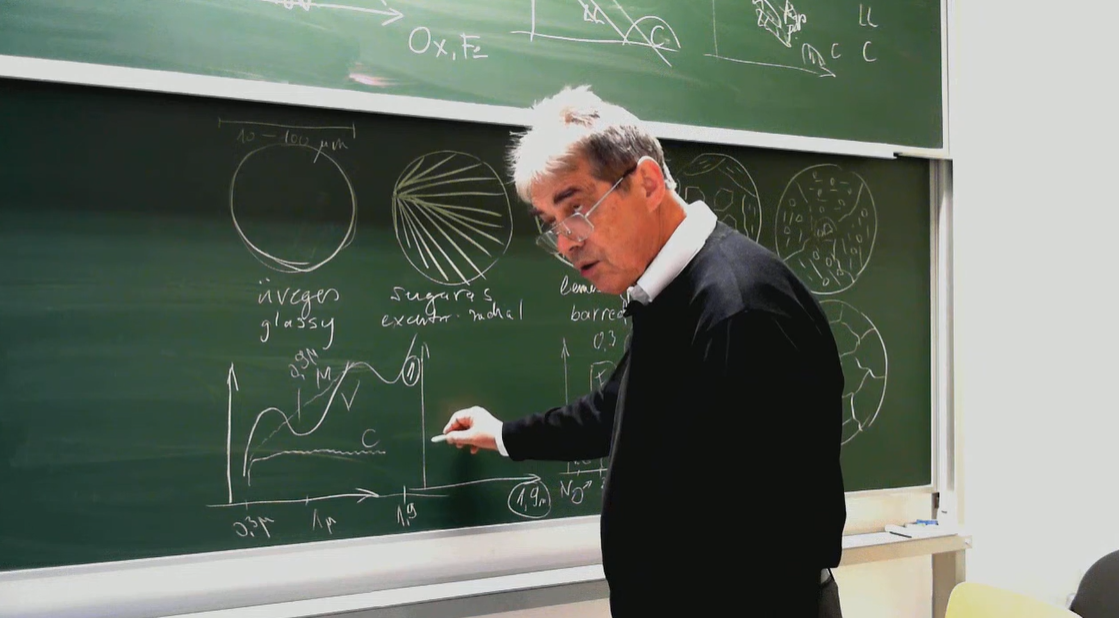 Meteorite studies and the evolutionary history of a small celestial bodySzaniszló Bérczi, 2020
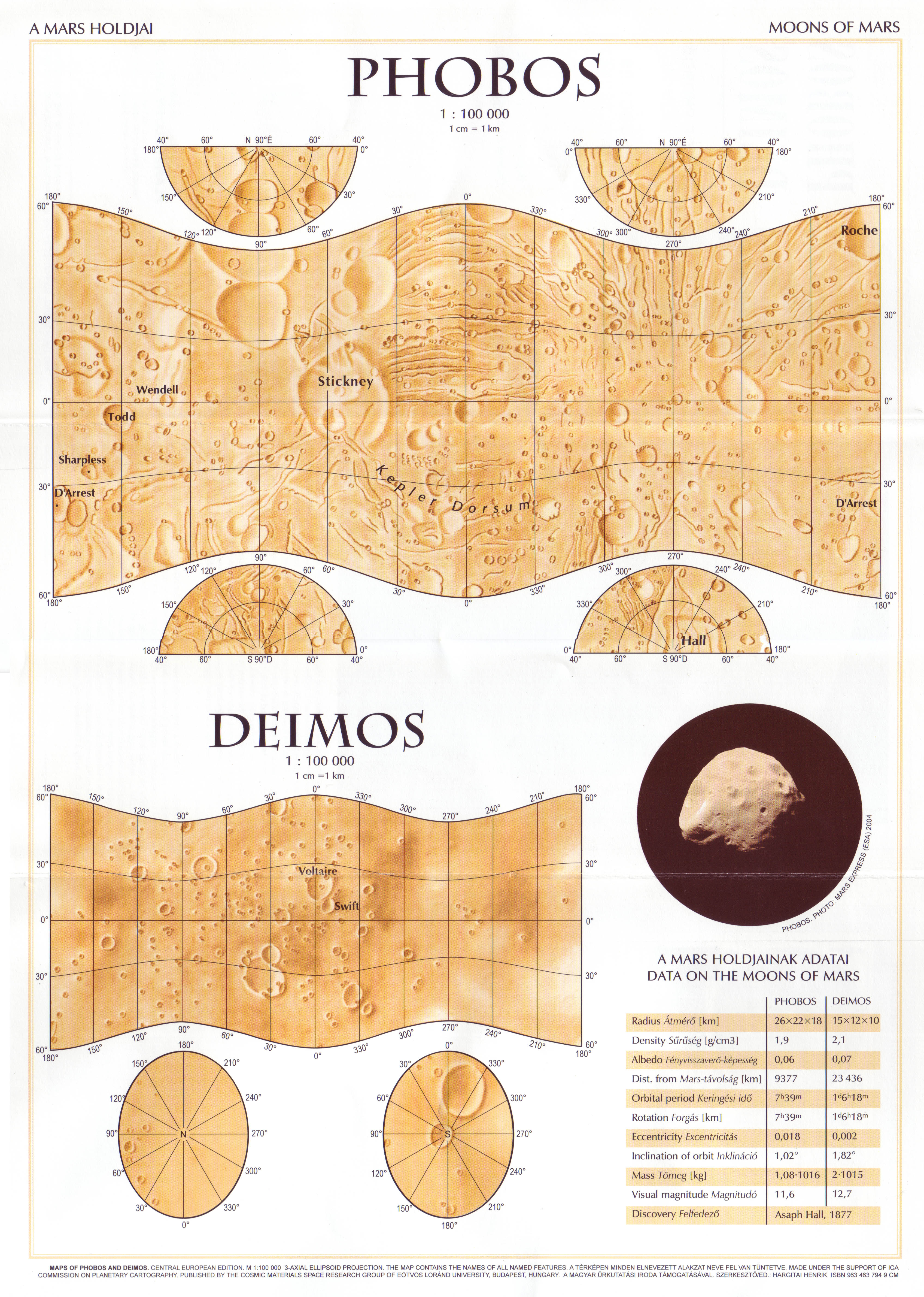
MAPS OF SMALL BODIES
| Map
of Phobos and Deimos
Budapest-Moscow, 2006 40x30 cm, Hungarian-English
|
 |
Small bodies
Asteroids
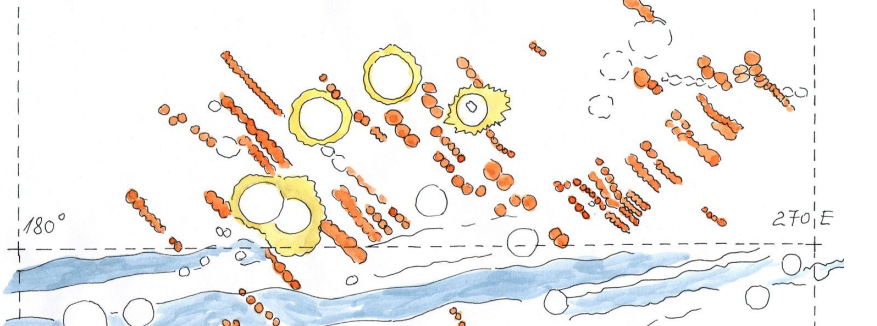
Horváth, A., Bérczi, Sz., & Illés-Almár, E. (2012). Stratigraphy of the rolling-printed groove-fields on Dawn images in order to reconstruct paleoaxes of 4 Vesta. 43. LPSC, #1402, LPI, Houston.
Bérczi, Sz., Holba, Á., & Lukács, B. (1995). Comparison of Apollo-Amor, Hungaria, Belt and Other Asteroids in a Filter-Spanned Colour Space. 20th NIPR Symp. Antarctic Meteorites, Tokyo, Japan, p. 22.
Bérczi, Sz., Holba, Á., & Lukács, B. (1994). On Discriminating Asteroid Spectra by Filtering. In B. Lukács, I. Kubovics, L. Stegena, & Sz. Bérczi (Eds.), Evolution of extraterrestrial materials and structures (MTA-KFKI-1994-22/C; pp. 57–73). MTA Központi Fizikai Kutatóintézet.
Comets and other small bodies
Vizi, P. G., Berczi, Sz., Csizmadia, Sz., & Hegedus, T. (2016). Extended Meteor Hunting With Smartphones as Surveillance Cameras. 47th LPSC, #1797. LPI, Houston, CD-ROM.Abstract (PDF) · Publisher / online source
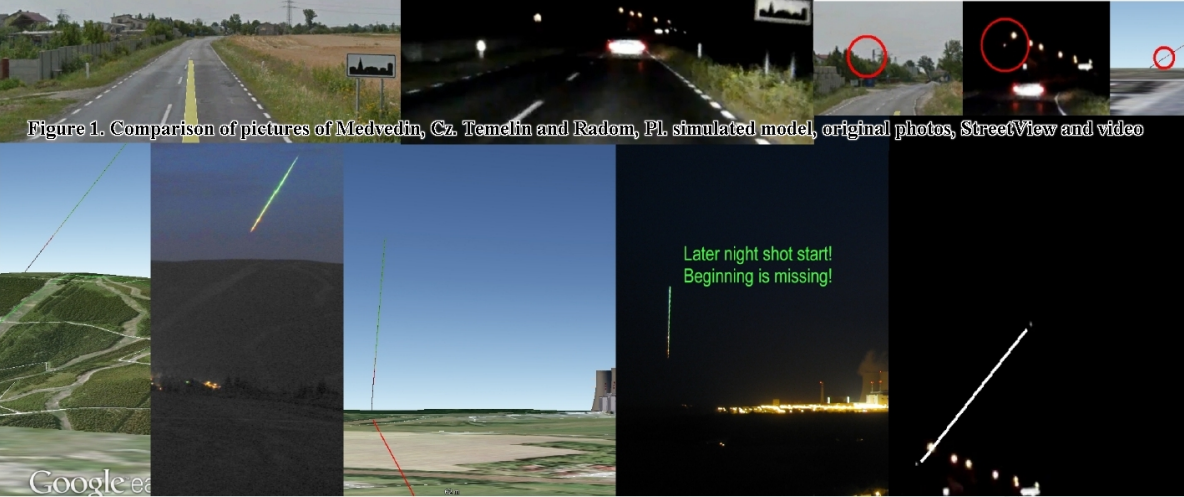
Vizi, P. G., Bérczi, Sz., Gucsik, A., Hegedűs, T., Lukács, B., Biró, Zs., Molnár, K., & Tepliczky, I. (2014). Fireball and Meteor Event 20130824190218UTC’Pilis’. 45th LPSC, #2838.Abstract (PDF)
Further publications by topic
Comets
Goetz, C., Richter, I., Carr, C., Cupido, E., Koenders, C., Vallat, C., Volwerk, M., Szegő, K., Tsurutani, B., & Glassmeier, K. (2015). A Statistical Survey of Low-Frequency Waves in the Inner Coma of Comet 67P/Churyumov-Gerasimenko. EGU, abstract #8789.
Mandt, K. E., Burch, J. L., Carr, C., Eriksson, A. I., Glassmeier, K., Lebreton, J., Nilsson, H., Beghin, C., Broiles, T. W., Clark, G., Cupido, E., Edberg, N., Galand, M., Goldstein, R., Henri, P., Koenders, C., Mokashi, P., Németh, Z., Pollock, C., …, Winterhalter, D. (2015). First Results at 67P/Churyumov-Gerasimenko with the Rosetta Plasma Consortium. LPSC, abstract #2312.
Lamy, P., Faury, G., Tóth, I., Jorda, L., Gaskell, R., Groussin, O., & Capanna, C. (2015). Photometric properties of the nucleus of 67P/Churyumov-Gerasimenko from OSIRIS/Rosetta, space telescope, and ground-based observations. DPS, abstract #413.03.
Wieser, G. S., Nilsson, H., Behar, E., Wedlund, C. S., Kallio, E. J., Gunell, H., Edberg, N. J., Eriksson, A. I., Yamauchi, M., Koenders, C., Wieser, M., Lundin, R. N. A., Mandt, K., Burch, J. L., Goldstein, R., Mokashi, P., Carr, C., Cupido, E., Fox, P. T., …, Geiger, B. (2015). The Evolution of Comet 67P as Seen by a Mass-Resolving Ion Spectrometer. AGU, abstract #P31E-2101.
Lamy, P., Tóth, I., Li, J., & Weaver, H. (2014). Constraints on the nucleus of comet C/2012 S1 (ISON) from the Hubble Space Telescope observations. ACM, abstract #325.
Lamy, P., Kamoun, P., Tóth, I., & Herique, A. (2014). Constraints on the subsurface structure and density of the nucleus of Comet 67P/Churyumov-Gerasimenko from radar observations. EGU, abstract #EGU2014-6993.
Jorda, L., Gaskell, R., Hviid, S., Capanna, C., Groussin, O., Gutierrez, P., Lamy, P., Scholten, F., Preusker, F., Kaasalainen, M., Keller, H., Knollenberg, J., Kührt, E., Mottola, S., Sierks, H., Snodgrass, C., Thomas, N., Tóth, I., & Vincent, J. (2014). Global Shape and Topography of the Nucleus of Comet 67P/C-G from ROSETTA/OSIRIS Images. EPSC, abstract #EPSC2014-665.
Lamy, P., Jorda, L., Kaasalainen, M., Hviid, S., Faury, G., Tóth, I., & Groussin, O. (2014). Preliminary solution for the shape and rotational state of the nucleus of comet 67P/Churyumov-Gerasimenko. ACM, abstract #324.
Li, J., Kelley, M., Farnham, T., A'Hearn, M., Knight, M., Weaver, H., Mutchler, M., Lamy, P., & Tóth, I. (2013). Early pre-perihelion characterization of Comet C/2012 S1 (ISON). DPS, abstract #407.02.
Lamy, P., Tóth, I., Jorda, L., Groussin, O., Faury, G., & Weaver, H. (2012). Comet 8P/Tuttle: A portrait of a contact-binary nucleus from Hubble and Spitzer space telescopes observations. EGU, abstract #EGU2012-10506.
O'Rourke, L., Küppers, M., Jorda, L., Bockelee-Morvan, D., Groussin, O., Müller, T., Kiss, C., Crovisier, J., Altieri, B., Gónzalez-García, B., Altwegg, K., & Schulz, R. (2012). Herschel Observations of the Rosetta Target 67P/Churyumov-Gerasimenko and Deep Impact/Stardust/Stardust NEXt Target 9P/Tempel-1. ACM, abstract #6292.
Fernandez, Y., Lowry, S., Meech, K., Laird, R., Fitzsimmons, A., Snodgrass, C., Weissman, P., Pittichova, J., Bauer, J., Weaver, H., Lisse, C., A'Hearn, M., Campins, H., Groussin, O., Kelley, M., Lamy, P., Licandro, J., Tóth, I., & Reach, W. (2012). Visible-Wavelength Survey of Jupiter-Family Cometary Nuclei as Part of SEPPCoN. ACM, abstract #6488.
Illés, Erzsébet (2011). Comet Hartley 2 and the Two Kinds of Cometary Sub-Nuclei. LPSC, abstract #1354.
Further research
Fu, X., Saveriano, F., Soldini, S., Ferrari, F., Richardson, D. C., Hirabayashi, M., Rossi, A., Fahnestock, E. G., Farnham, T. L., Gucsik, A., Ivanovski, S. L., Jutzi, M., Kereszturi, A., Li, J., Marzari, F., Merrill, C. C., Moreno, F., Raducan, S. D., Rizos, J. L., …, Michel, P. (2025). Orbital Capture of Ejecta into Periodic Orbits around Binary Asteroid (65803) Didymos. Planetary Science Journal, 6(7), 174. https://doi.org/10.3847/PSJ/ade8eb
The study models ejecta trajectories around the Didymos binary asteroid after the DART impact. It investigates which launch locations, speeds and directions could place particles on repeating orbits under the combined effects of gravity and sunlight pressure. Source
Szakáts, R., Kiss, C., & Müller, T. (2025). Photometry of serendipitously observed asteroids with Herschel/PACS. EPSC-DPS Joint Meeting 2025, Helsinki, Finland, abstract #EPSC-DPS2025-1349.
The researchers search archived Herschel observations for asteroids that happened to pass through the field of view. Measuring their infrared emission provides information about physical properties for which dedicated observations are scarce. Source
Takács, N., Kiss, C., Szakáts, R., Plachy, E., Kalup, C., Szabó, G. M., Molnár, L., Sárneczky, K., Szabó, R., Bódi, A., & Pál, A. (2025). Probing Internal Structure Through Extremes: The Fastest Rotators Among Hilda and Jovian Trojan Asteroids. EPSC-DPS Joint Meeting 2025, Helsinki, Finland, abstract #EPSC-DPS2025-266.
TESS observations identify exceptionally fast-spinning Hilda and Jupiter Trojan asteroids. Their rotation rates help estimate the density or internal cohesion needed to keep these bodies from breaking apart. Source
Najda, K., Podlewska-Gaca, E., Bartczak, P., Takács, N., Kiss, C., Bosh, J. M., Kamiński, K., Kamińska, M., & Polińska, M. (2024). Determination of physical parameters of asteroids based on data from space and ground-based telescopes.. EPSC, abstract #EPSC2024-340.
Observations by professional and amateur astronomers are combined with space-telescope data to model asteroids. Brightness changes recorded from many directions help estimate shape and rotation details that a single observation cannot reveal. Source
Takács, N., Plachy, E., Sódorné Bognár, Z., Szakáts, R., Takács, D., Bódi, A., Marton, G., Pál, A., Szabó M., G., Molnár, L., Sárneczky, K., Vinkó, J., Szabó, R., Kiss, C., Bartczak, P., & Podlewska-Gaca, E. (2024). Exploring the physical properties of Jupiter Trojans and Hildas with the TESS space telescope. EPSC, abstract #EPSC2024-100.
Long, continuous TESS observations are used to study rotation among Hilda and Jupiter Trojan asteroids. Comparisons with ground-based data examine the frequency of slow rotators and differences between asteroid groups. Source
Takács, N., Kiss, C., Pál, A., & Szakáts, R. (2024). Shape and rotation modelling of asteroids based on multi-directional TESS measurements. EPSC, abstract #EPSC2024-101.
TESS measurements from several viewing directions are used to model approximate asteroid shapes and spin axes. Brightness variations help separate the effects of shape and viewing geometry, extracting more physical information from the telescope's data. Source
Takács, N., Pál, A., & Kiss, C. (2022). Spin-axis and rotation of small bodies using multi-directional measurements of the Transiting Exoplanet Survey Satellite. EPSC, abstract #EPSC2022-1225.
Brightness changes of asteroids observed by TESS from several directions are used to estimate their shapes and spin axes. Comparisons with existing models test how reliably large space-telescope surveys can provide this information. Source
Kiss, C., Takácsné Farkas, A., Szakáts, R., Müller, T., & Pál, A. (2021). Dwarf planet light curves with TESS. EPSC, abstract #EPSC2021-123.
Szakáts, R., Kiss, C., Müller, T., Alí-Lagoa, V., & Pál, A. (2021). Photometry of main belt asteroids from serendipitous Herschel/PACS observations. EPSC, abstract #EPSC2021-761.
Marciniak, A., Durech, J., Ali-Lagoa, V., Ogloza, W., Szakáts, R., Muller, T., Molnár, L., Pál, A., & Monteiro, F. (2021). Properties of long-period asteroids from simultaneous optimisation using visible and thermal data. EPSC, abstract #EPSC2021-29.
Gucsik, A., Futó, P., Vitéz, L., Viczián-Dombai, R., Nyíri, Z., Szarvas, R., Nagy, A., Nagy, D., Simonia, I., Vanyó, J., Csámer, Á., Rázsi, A., Kristály, F., & Veres, M. (2021). Shock Stage Clarification of Plagioclase Samples from Asteroid Itokawa Using Raman and Cathodoluminescence Microscopy and Spectroscopy. LPSC, abstract #2781.
Szakáts, R., Kiss, C., Müller, T., Marton, G., Alí-Lagoa, V., Takácsné Farkas, A., & Bányai, E. (2021). Update on the SBNAF Infrared Database. EPSC, abstract #EPSC2021-686.
Szakáts, R., Kiss, C., Müller, T., Alí-Lagoa, V., Marton, G., Takácsné Farkas, A., & Bányai, E. (2019). 'Small Bodies: Near and Far' database for thermal infrared observations of Solar System small bodies. EPSC, abstract #EPSC-DPS2019-1314.
Sztakovics, J., Forgácsné Dajka, E., Sándor, Z., Vanyó, J., & Gucsik, A. (2019). Statistical Study of Mean Motion Resonances and Physical Properties of Hungaria Asteroids Using FAIR. LPSC, abstract #2674.
Skultéti, Á., & Kereszturi, Á. (2018). Ideal method for asteroid compositional analysis - mid-infrared spectral work with DRIFTs for HERA mission. EPSC, abstract #EPSC2018-81.
Kiss, C., Marton, G., Parker, A., Grundy, W., Takácsné Farkas, A., Stansberry, J., Pál, A., Müller, T. G., Noll, K., Schwamb, M. E., Barr, M. A. C., Young, L. A., & Vinkó, J. (2018). The mass and density of the dwarf planet 2007 OR10. DPS, abstract #id.311.02.
Lagoa, V. M. A., Müller, T. G., Marciniak, A., Kiss, C., Duffard, R., Bartczak, P., Butkiewicz-Bak, M., Dudzinski, G., Fernández-Valenzuela, E., Marton, G., Morales, P. N., Ortiz, J. L., Podlewska-Gaca, E., Oszkiewicz, D., Santana-Ros, T., Santos-Sanz, P., Szakáts, R., Takácsné Farkas, A., & Verebélyi, E. (2018). Thermal properties of large main belt asteroids derived from Herschel PACS data. DPS, abstract #id.408.01.
Müller, T., Kiss, C., & Ali-Lagoa, V. (2017). Herschel-PACS high-precision FIR fluxes of NEAs and MBAs. EPSC, abstract #486.
Marton, G., Kiss, C., Takácsné Farkas, A., & Ignácz, B. (2017). Search for signatures of extended emission around dwarf planets on Hubble Space Telescope archival images. DPS, abstract #216.05.
Szakáts, R., Kiss, C., Marton, G., Verebélyi, E., Müller, T., & Pál, A. (2017). Serendipitous observations of asteroids in Herschel PACS and SPIRE maps. EPSC, abstract #223.
Müller, T., Marciniak, A., Kiss, C., Duffard, R., Ali-Lagoa, V., Bartczak, P., Butkiewicz-Bak, M., Dudzinski, G., Fernandez-Valenzuela, E., Marton, G., Morales, N., Ortiz, J. -., Oszkiewicz, D., Santana-Ros, T., Santos-Sanz, P., Szakáts, R., Takácsné Farkas, A., & Verebélyi, E. (2017). Small Bodies Near and Far (SBNAF): Characterization of asteroids and TNOs. EPSC, abstract #474.
Pál, A., Kiss, C., Molnár, L., Müller, T., Sárneczky, K., Szabó, R., Kiss, L. L., & Szabó M., G. (2016). K2 and Herschel/PACS photometry of irregular satellites. DPS, abstract ##519.09.
Szabó M., G., Kiss, C., Pál, A., & Szabó, R. (2016). Photometry of Main Belt and Trojan asteroids with K2. DPS, abstract #410.04.
Duffard, R., Mueller, T., Marciniak, A., Santana-Ros, T., Ortiz, J., Santos-Sanz, P., Fernandez-Valenzuela, E., Kiss, C., Verebélyi, E., Bartczak, P., Butkiewicz-Bak, M., Dudziński, G., Szakáts, R., & Takácsné Farkas, A. (2016). Small Bodies: Near and Far (SBNAF). DPS, abstract #326.08.
Stansberry, J., Müller, T., Lellouch, E., Barucci, A., Fornasier, S., Kiss, C., Lacerda, P., Lim, T., Mommert, M., Ortiz, J., Pál, A., Santos-Sanz, P., Vilenius, E., & Herschel, ". A. C. ". T. (2013). TNOs are Cool! Summary Results from the Herschel Key Programme. DPS, abstract #508.05.
Santos-Sanz, P., Ortiz, J. L., Lellouch, E., Takácsné Farkas, A., Kiss, Cs., Müller, T., Vilenius, E., Thirouin, A., Duffard, R., & TNOs, a. C. T. (2013). Thermal light curve of 20000 Varuna with Herschel-PACS. EPSC, abstract #EPSC2013-665.
O'Rourke, L., Müller, T., Altieri, B., Gónzalez-García, B., Kiss, C., Pál, A., Barucci, A., Yoshikawa, M., Dotto, E., Küppers, M., & Sanchez, P. M. (2012). Herschel Observations of the Hayabusa-2 Asteroid 162173 (1999 JU3). ACM, abstract #6299.
Pál, A., Kiss, C., Muller, T., Vilenius, E., Rengel, M., Mommert, M., Santos-Sanz, P., Lellouch, E., & Stansberry, J. (2012). Surface Properties of Extreme TNOs Based on Herschel/PACS measurements: The Case of Sedna and 2010 EK139. ACM, abstract #6368.
Futó, P., Gucsik, A., & Kimura, Y. (2012). The effect of the variable C/O ratio on the bulk mineralogy of carbon – rich asteroidal interiors.. ACM, abstract #abstract 2028.
Futó, P., Gucsik, A., & Kimura, Y. (2012). The plausible bulk mineralogies for the rocky asteroidal interiors in the nearby planetary systems.. ACM, abstract #1.
Müller, T., O'Rourke, L., Barucci, A., Pál, A., Kiss, C., Zeidler, P., Altieri, B., González-García, B., & Küppers, M. (2012). Thermal, Shape and Surface Properties of OSIRIS-REx Target Asteroid (10955) 1999 RQ36 — Derived from Herschel, ESO-VISIR and Spitzer Observations. ACM, abstract #6312.
Faury, G., Lamy, P., Vernazza, P., Jorda, L., & Tóth, I. (2011). Asteroids (21) Lutetia: global and spatially resolved photometric properties. EPSC-DPS Joint Meeting, abstract #EPSC-DPS2011-759.
Horváth, A., & Illés, E. (2011). Grooves on 21 Lutetia Indicate a Layered Structure. LPSC, abstract #1366.
Vilenius, E., Müller, T., Pál, A., Santos-Sanz, P., Rengel, M., Hartogh, P., Protopapa, S., Mueller, M., Mommert, M., Stansberry, J., Lellouch, E., Böhnhardt, H., Ortiz, J. L., Thirouin, A., Henry, F., De lsanti, A., Fornasier, S., Hestroffer, D., & Dotto, E. (2011). TNOs are Cool: Thermophysical modeling of a sample of 20 classical KBOs using Herschel/PACS. EPSC-DPS Joint Meeting, abstract #EPSC-DPS2011-1299.
Santos-Sanz, P., Kiss, C., Lellouch, E., Müller, T., Stansberry, J., Böhnhardt, H., Lacerda, P., Ortiz, J., Thirouin, A., Duffard, R., Pál, A., Vilenius, E., Fornasier, S., Lim, T., & 'Tnos, A. C. T. (2011). Thermal lightcurve observations of TNOs with Herschel. EPSC-DPS Joint Meeting, abstract #EPSC-DPS2011-1099.
Tepliczky, I., & Kereszturi, A. (2002). Signs of changes in the electrostatic sedimentationt on Eros. 33rd Lunar and Planetary Science Conference (Abstract No. 1656). Lunar and Planetary Institute.
Sárneczky, K., & Kereszturi, A. (2002). “Global” tectonism on asteroids?. 33rd Lunar and Planetary Science Conference (Abstract No. 1381). Lunar and Planetary Institute.
Trans-Neptunian objects and dwarf planets
Kiss, C., Gabányi, K. É., Moór, A., Thomas, M., Estela, F., Arielle, M., Tamás, B., & Kalup, C. (2025). ALMA submm measurements of the trans-Neptunian binary system satellites Ilmarë, Actaea, Hi’iaka and Namaka. EPSC-DPS Joint Meeting 2025, Helsinki, Finland, abstract #epsc-dps2025-905.
ALMA observations investigate thermal emission from several satellites of trans-Neptunian bodies. The measurements help constrain their physical properties and test formation scenarios involving large impacts. Source
Kalup, C., & Kiss, C. (2025). Characterising Grains and Composition in Small-Body Ring Systems: A Case Study of Haumea's Ring. EPSC-DPS Joint Meeting 2025, Helsinki, Finland, abstract #EPSC-DPS2025-1768.
The study seeks to better constrain grain sizes and composition in Haumea's ring. This information can help distinguish proposed origins and explain how a ring around a small body remains stable. Source
Protopapa, S., Wong, I., Johnson, P., Grundy, W. M., Emery, J. P., Lellouch, E., Holler, B., Glein, C. R., Kiss, C., Müller, T., Brunetto, R., Cartwright, R. J., Guilbert-Lepoutre, A., Hammel, H. B., Milam, S. N., Parker, A. H., Pinilla-Alonso, N., Raut, U., Santos-Sanz, P., & Stansberry, J. (2025). JWST/NIRSpec Observations of Makemake: Hydrocarbon Chemistry and Surface Processes on a Methane-Rich Trans-Neptunian Object. EPSC-DPS Joint Meeting 2025, Helsinki, Finland, abstract #EPSC-DPS2025-968.
James Webb observations examine infrared signatures on Makemake's methane-rich surface. Hydrocarbons and ice composition provide clues to how irradiation and temperature changes alter this distant world. Source
Forgácsné Dajka, E., Kővári, E., Kovács, T., Sándor, Z., & Kiss, C. (2024). Dynamical and Chaotic Structures in the Trans-Neptunian Region: Insights from Resonance Analysis and Diffusion Rates. EPSC, abstract #EPSC2024-1361.
The study examines thousands of trans-Neptunian orbits and the repeated gravitational effects of planets. Mapping stable and chaotic regions provides clues to past giant-planet migration and the long-term evolution of small bodies. Source
Szakáts, R., Kiss, C., Ortiz, J. L., Morales, N., Pál, A., Müller, T., Greiner, J., Santos-Sanz, P., Marton, G., Duffard, R., Sági, P., & Forgácsné Dajka, E. (2024). Tidally locked rotation and spin phase dependent J - H color of the dwarf planet (136199) Eris. EPSC, abstract #EPSC2024-1046.
Ground-based and space-telescope observations are used to study Eris's brightness variations. The results suggest rotation synchronized with its moon Dysnomia's orbit; modeling this process also constrains the moon's mass and the system's evolution. Source
Farkas-Takács, A., Kiss, C., Góbi, S., & Kereszturi, Á. (2022). Serpentinization in the Thermal Evolution of Icy Kuiper Belt Objects in the Early Solar System. Planetary Science Journal, 3(3), 54. https://doi.org/10.3847/PSJ/ac5175
The paper models heat-producing reactions between water and rock in icy bodies of the early Solar System. Under some conditions, the calculations suggest that the process can reinforce itself and substantially alter their interiors. Source
Takácsné Farkas, A., Kiss, C., Góbi, S., & Kereszturi, Á. (2021). Serpentinization in the thermal evolution of icy Kuiper belt objects in the early Solar system. EPSC, abstract #EPSC2021-543.
Takácsné Farkas, A., Kiss, C., Müller, T., & Mommert, M. (2019). Makemake's thermal emission reconsidered. EPSC, abstract #EPSC-DPS2019-86.
Kiss, C., Szakáts, R., Molnár, L., Pál, A., Marton, G., Takácsné Farkas, A., Szabó M., G., Szabó, R., Sárneczky, K., Kecskeméthy, V., Kalup, C., Vinkó, J., Müller, T., Marciniak, A., Duffard, R., & Kiss, L. L. (2019). New census of Hilda, Jovian Trojan, Centaur and transneptunian object light curves from K2 measurements. EPSC, abstract #EPSC-DPS2019-848.
Marton, G., Molnár, L., Kiss, C., Pál, A., & Müller, T. G. (2018). K2 light curves of eight Centaurs. DPS, abstract #id.305.02.
Parker, A., Buie, M. W., Grundy, W., Noll, K., Young, L., Schwamb, M. E., Kiss, C., Marton, G., & Takácsné Farkas, A. (2018). The Mass, Density, and Figure of the Kuiper Belt Dwarf Planet Makemake. DPS, abstract #id.509.02.
Marton, G., Kiss, C., Müller, T. G., Lellouch, E., Pál, A., & Molnár, L. (2017). K2 and Herschel/PACS light curve of the Centaur 2060 Chiron. EPSC, abstract #213.
Kiss, C., Kóspál, Á., Moór, A., Pál, A., Takácsné Farkas, A., Ignácz, B., & Müller, T. (2017). Spatially resolved thermal emission of the Eris-Dysnomia system. DPS, abstract #504.10.
Santos-Sanz, P., Ortiz, J. L., Sicardy, B., Rossi, G., Berard, D., Morales, N., Duffard, R., Braga-Ribas, F., Hopp, U., Ries, C., Nascimbeni, V., Marzari, F., Granata, V., Pál, A., Kiss, C., Pribulla, T., Milan, K. R., Hornoch, K., Pravec, P., …, Campo, B. A. (2017). The stellar occultation by the dwarf planet Haumea. DPS, abstract #504.08.
Kiss, C., Müller, T., Lellouch, E., Vilenius, E., & Kóspál, Á. (2017). Thermal emission of the Eris-Dysnomia system. EPSC, abstract #2017-721.
Kiss, C., Pál, A., Takácsné Farkas, A., Marciniak, A., Mueller, T., Kiss, L. L., Szabó M., G., Szabó, R., Sárneczky, K., & Molnár, L. (2016). Physical characteristics of Cenaturs and trans-Neptunian objects from combined K2 and Herschel observations. DPS, abstract ##106.02.
Takácsné Farkas, A., Kiss, C., Mueller, T., Mommert, M., & Vilenius, E. (2016). Properties of resonant trans-Neptunian objects based on Herschel Space Observatory data. DPS, abstract #113.06.
Kiss, C., Horner, J., Pál, A., Szakáts, R., Vilenius, E., Acosta-Pulido, J., Sárneczky, K., Szabó M., G., & Duffard, R. (2014). The extreme Centaur 2013 AZ_{60}. ACM, abstract #291.
Duffard, R., Pinilla-Alonso, N., Santos-Sanz, P., Vilenius, E., Ortiz, J., Mueller, T., Fornasier, S., Lellouch, E., Mommert, M., Pál, A., Kiss, C., Mueller, M., Stansberry, J., Delsanti, A., & Peixinho, N. (2013). A Herschel-PACS view of 16 Centaurs. DPS, abstract #508.04.
Müller, T., Vilenius, E., Santos-Sanz, P., Mommert, M., Kiss, C., Pál, A., & TNOs-are-Cool, T. (2012). TNOs are Cool: A Survey of the Trans-Neptunian Region — Herschel Observations and Thermal Modeling of Large Samples of Kuiper Belt Objects. ACM, abstract #6316.
Kiss, C., Vilenius, E., Müller, T., Pál, A., Rengel, M., Mommert, M., Szalai, N., Santos-Sanz, P., Lellouch, E., & Stansberry, J. (2012). Thermal Emission of the Eris — Dysnomia System as Observed by Herschel/PACS. ACM, abstract #6357.
Müller, T., Lellouch, E., Kiss, C., Lim, T., Fornasier, S., Santos-Sanz, P., Vilenius, E., Delsanti, A., Duffard, R., Hartogh, P., Henry, F., Mommert, M., Müller, M., Szalai, N., Stansberry, J., & Ortiz, J. L. (2011). Makemake: A truly exotic TNO!. EPSC-DPS Joint Meeting, abstract #EPSC-DPS2011-1416-1.
Stansberry, J., Müller, T., Ortiz, J., Santos-Sanz, P., Vilenius, E., Lellouch, E., & Kiss, C. (2011). Physical Properties of the Haumea Family from Herschel. EPSC-DPS Joint Meeting, abstract #EPSC-DPS2011-1437.
Kiss, C., Pál, A., Müller, T., Santos-Sanz, P., Vilenius, E., Szalai, N., Lellouch, E., & Bönhardt, H. (2011). Sedna, Eris and Quaoar: physical properties of prominent trans-Neptunian objects, based on Herschel observations. EPSC-DPS Joint Meeting, abstract #EPSC-DPS2011-1124-1.
Fornasier, S., Lim, T., Müller, T., Panuzzo, P., Santos-Sanz, P., Vilenius, E., Bönhardt, H., Stansberry, J., Delsanti, A., Henry, F., Kiss, C., Pál, A., Duffard, R., Barucci, A., & Dotto, E. (2011). Sub-millimeter observations of Centaurs and TNOs from the Herschel space telescope. EPSC-DPS Joint Meeting, abstract #EPSC-DPS2011-712.
Mommert, M., Harris, A., Müller, T., Stansberry, J., Lellouch, E., Böhnhardt, H., Delsanti, A., Duffard, R., Fornasier, S., Hartogh, P., Henry, F., Kiss, C., Mueller, M., Pál, A., Protopapa, S., Santos-Sanz, P., Szalai, N., Rengel, M., & Vilenius, E. (2011). TNOs are Cool: A Survey of the Transneptunian Region - Physical Characterization of 16 Plutinos using PACS observations. EPSC-DPS Joint Meeting, abstract #EPSC-DPS2011-906-1.
Müller, T., Lellouch, E., Böhnhardt, H., Stansberry, J., Kiss, C., Santos-Sanz, P., Vilenius, E., Protopapa, S., Moreno, R., & Mueller, M. (2010). TNOs are Cool: A survey of the Transneptunian region with Herschel Space Observatory. EPSC, abstract #668.
Lacerda, P., Lellouch, E., Kiss, C., Müller, T., Groussin, O., & Santos-Sanz, P. (2010). The thermal lightcurve of Kuiper belt object Haumea. EPSC, abstract #505.