Ákos Kereszturi reporting
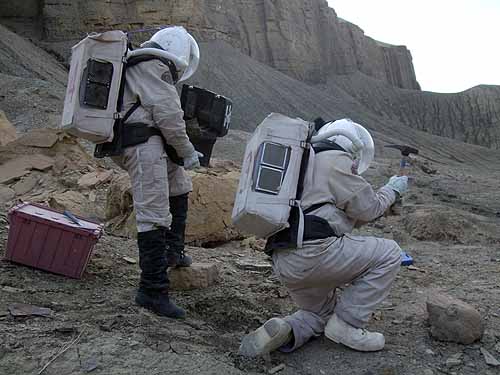
During the crew rotation previously visited and new sites were also observed. The aims were analyze the optimal method and routs for the analysis of different terrain types, their possible extrapolation to Martian environment, and samples of cryptobiotic crust were collected. During the crew rotation the Skyline Rim, some rocks next to the Candor Chasma, and Glisterning Seas were visited by EVAs.
In the first project we found, that in most cases the best routes are determined by the access possibilities, and not by the geological aspects of the target. The observed sizes of various formations were in the scale of 100 meter and kilometer, their simple general analysis required 0,5-1 hour per each formation. Based on our current knowledge, the up-to date observed geologic structures by rovers are in this range, but the spacecraft observed targets ar larger than 2-3 orders than this, making it difficult to gain general knowledge during 1-2 EVAs or 1-2 sols.
The most important aims were find samples of cryptobiotic crust and analyze back on Earth. Nice crusts were found mostly on rocks larger than about 2-4 meter, on hand specimen were rare. This later may be in connection with the weathering, where large boulders have better resistance weathering and have more time to develop crusted surfaces. The collected samples showed dark “burned” surfaces and green layer 1-3 mm below it. Their detailed analysis will take at the Earth by specialists.
Large, rock covering lichens were found near to the Phobos Peak. They appeared at the higher part of the hill, and only on the shadowed northern part of the top, around the large rock. Their high location around the top of small hills and rocks coincides with the observation around FMARS at Devon-island. Probably the condensation of the vapor is easy at theses locations by some hypothetic electrostatic effect – but the detailed interpretation is unknown. At Phobos Peak the shadowed location may be in connection with the temperature: these shadowed parts are less hot around noon and any water inside the rock fractures may stay there for a longer period, producing better microenvironment for these living organisms.
At the foot of the Skyline Rim whitish salt-like deposits were observed
in small runoff channels on debris slopes. The bright surface cover had
a thickness of 1-2 mm, and located only at the south facing slopes of the
channels’ cross sectional profile, and not on the opposite slope wall.
This is possibly in connection with the insolation and preferred evaporation
of subsurface fluid.